
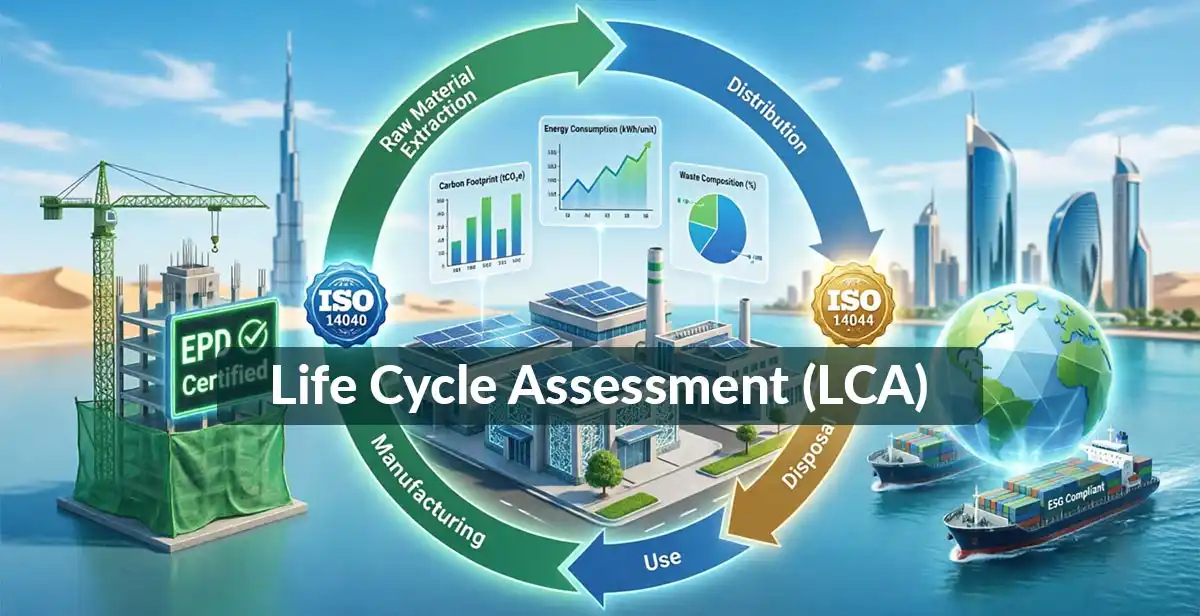
A Life Cycle Assessment (LCA) measures a product’s environmental impact across its full life — from raw materials to disposal. GCC manufacturers need LCA studies to earn Environmental Product Declarations (EPDs), win green building tenders, meet ESG goals, and access export markets. LCA follows ISO 14040 and ISO 14044.
Green building rules across the GCC are tightening fast. Buyers want proof, not promises. They want verified numbers on carbon, energy, and waste.
A Life Cycle Assessment gives them those numbers. It also forms the data behind every Environmental Product Declarations.
This guide is written for manufacturers, sustainability managers, ESG teams, and compliance staff in the UAE, Saudi Arabia, Qatar, Oman, Kuwait, and Bahrain.
Picture a steel manufacturer in Abu Dhabi. A major NEOM tender lands on the desk. The brief asks for an EPD on every structural product. No EPD means no bid. To get that EPD, the manufacturer first needs an LCA study. This guide explains how that process works.
What Is Life Cycle Assessment (LCA)?
Life Cycle Assessment is a science-based method that measures a product’s environmental impact across its full life. It tracks all inputs and outputs, from raw material extraction to disposal. LCA follows ISO 14040 and ISO 14044.
An LCA looks at every stage of a product’s life. It measures carbon, energy, water, and waste. Each impact is shown in a standard unit. This makes products easy to compare.
The results feed directly into an EPD. Without an LCA, no EPD can be issued or verified.
Here are the key terms you will meet in this guide:
- LCA (Life Cycle Assessment): The full study of a product’s environmental impact across its life.
- EPD (Environmental Product Declaration): A verified document that declares LCA results to buyers.
- LCI (Life Cycle Inventory): The data stage. It lists every input and output of the product system.
- LCIA (Life Cycle Impact Assessment): The calculation stage. It turns inventory data into impact scores.
Learn more in our guide to the Environmental Product Declaration.
Why GCC Manufacturers Need an LCA Study
Demand for LCA studies is rising fast across the region. Green building schemes, export rules, and ESG targets all drive it.
UAE Sustainability Requirements
LEED and Estidama projects shape demand in the UAE. Abu Dhabi’s Estidama Pearl Rating System accepts EPDs for materials credits. Dubai runs large construction pipelines with green targets.
Suppliers of cement, steel, glass, tiles, and insulation feel this most. An LCA-backed EPD keeps your product in the bid.
Saudi Vision 2030 and NEOM
Saudi Vision 2030 drives green building growth across the Kingdom. Mostadam is the Saudi green building rating system. It values EPD data.
LEED-certified projects in Riyadh, Jeddah, and NEOM require EPDs. To supply these projects, you need a verified LCA study first.
Qatar Green Building Requirements
Qatar’s construction sector continues to grow. Green building projects there increasingly ask suppliers for EPD data. An LCA study is the first step toward meeting that demand.
Export Market Pressure (CBAM)
The EU Carbon Border Adjustment Mechanism (CBAM) targets carbon-heavy imports. GCC exporters of steel, cement, and aluminum face new reporting duties. A verified LCA helps you measure and prove your product carbon footprint.
This prepares your product for sale in the EU and UK markets.
ESG Reporting Requirements
Corporate ESG reporting now reaches deep into supply chains. Buyers ask suppliers for Scope 3 emissions data. LCA results give you the numbers to report with confidence.
Here are the business benefits of an LCA study at a glance:
- Win more bids: EPDs open doors to green building projects.
- Meet export rules: A verified carbon footprint supports CBAM compliance.
- Stand out: Verified data beats unproven marketing claims.
- Report with proof: Solid numbers support ESG and Scope 3 reporting.
- Future-proof: You get ahead of tightening green rules.
ISO 14040 and ISO 14044 — The Standards Behind Every LCA
Every LCA study follows a clear set of global standards. These rules make each study consistent and comparable.
| Standard | Type | What It Covers |
| ISO 14040 | Framework | The four LCA phases and core principles |
| ISO 14044 | Requirements | Data quality, allocation rules, and LCA methods |
| EN 15804 | Core rules | Construction EPD modules and impact categories |
| ISO 21930 | Global | Sustainability rules for construction products |
ISO 14040 sets the framework. It defines the four phases of an LCA. ISO 14044 adds the detailed rules. It covers data quality and how to run the study.
In the GCC, EPD programmes use EN 15804 and ISO 21930 as their base rules. Product Category Rules (PCRs) add product-specific guidance on top.
The Four Phases of Life Cycle Assessment — Explained Simply
Every LCA follows four phases. Each one builds on the last. ISO 14040 defines all four.
Phase 1 — Goal and Scope Definition
This phase sets the plan. You define what the study aims to show. You set the functional unit, which is the unit of measure for the product.
You also define the system boundary. This decides which life cycle stages the study includes. The right PCR is chosen here too.
Phase 2 — Life Cycle Inventory (LCI)
This is the data stage. You gather primary data from your own factory. This includes energy use, raw materials, water, and waste per unit.
Background data from databases like ecoinvent fills any gaps. Good factory records make this stage fast and cheap.
Phase 3 — Life Cycle Impact Assessment (LCIA)
This is the calculation stage. The data is entered into LCA software. Each input is linked to an environmental impact factor.
The software adds up the scores across all life cycle stages. The result is a set of impact numbers in standard units.
Phase 4 — Interpretation
This phase reviews the results. You check the numbers against expected values for your product type. You run a sensitivity check and a data quality review.
The findings are then written into the LCA report.
Picture a tile manufacturer in Ras Al Khaimah. The team gathers twelve months of energy and clay data. The consultant builds the model and runs the LCIA. The results show a high firing-stage carbon footprint. With that insight, the manufacturer can target real cuts — and back the EPD with solid data.
LCA Software and Databases Used in GCC Studies
LCA software does the heavy lifting on calculations. EPD programme operators accept several tools.
| Tool / Database | Type | Best For | Notes |
| SimaPro | Paid software | Professional EPD consulting | Widely used by consultants |
| OpenLCA | Free software | GCC projects, cost saving | Open-source, supports ecoinvent |
| ecoinvent | Database | Background LCA data | The global standard data source |
| ILCD Handbook | Methodology guide | Method and quality rules | Supports consistent LCA practice |
In the GCC, OpenLCA and SimaPro are the most common tools. Both support the ecoinvent database and EN 15804 methods. EnviroLink uses both, depending on the product and programme.
LCA vs EPD — What Is the Difference?
Quick answer: An LCA is the study that measures a product’s environmental impact. An EPD is the verified document that declares those results to buyers. You need an LCA first; the EPD comes second.
| Feature | LCA | EPD |
| What it is | The study and the data | The published, verified document |
| Main output | Impact numbers and a report | A buyer-facing declaration |
| Verification | Reviewed within the EPD process | Verified by a third party |
| Who reads it | Consultants and verifiers | Architects, buyers, project teams |
| Standards | ISO 14040, ISO 14044 | EN 15804, ISO 21930, PCR |
Think of the LCA as the engine and the EPD as the finished car. One powers the other. For a related comparison, see our guide on EPD vs HPD.
What Does an LCA Study Actually Cost in UAE?
Cost depends on product type and data quality.
Factors That Affect LCA Cost
- Product complexity: More inputs and a longer supply chain raise the cost.
- Data quality: Good factory records cut the cost. Poor records add work.
- Number of factories: Multiple sites need more data collection.
- Verification and fees: Third-party checks and registration add to the total.
| LCA Study Type | Typical Cost (USD) | Timeframe |
| Simple product LCA | 3,000 – 6,000 | 6 – 8 weeks |
| Medium product LCA | 6,000 – 10,000 | 8 – 12 weeks |
| Complex product LCA | 10,000 – 15,000+ | 12 – 16 weeks |
| Industry-wide EPD | Cost shared by group | 3 – 6 months |
Verifier fees usually run from USD 1,500 to USD 4,000. Programme registration adds another USD 500 to USD 2,000. These sit on top of the study fee.
Picture an insulation manufacturer in Dubai with five product types. Studying each one alone would be costly. EnviroLink batches the products into one program. Shared data and a common PCR cut the cost per product.
How to Choose an LCA Consultant in Dubai or UAE
The right consultant saves time, cost, and stress. Use this checklist to guide your choice.
What to look for:
- ✓ Proven knowledge of ISO 14040, ISO 14044, and EN 15804
- ✓ Experience with GCC projects and regional data
- ✓ Skill in SimaPro or OpenLCA
- ✓ A strong record of first-pass verification
- ✓ Clear, fixed-fee packages
What to avoid:
- ✗ Vague pricing with hidden fees
- ✗ No experience with your product type
- ✗ Poor knowledge of PCR selection
- ✗ No support through verification and publication
Questions to Ask Before Hiring
- Which standards and PCRs will you use for my product?
- How many EPDs have you delivered in the GCC?
- What software and databases do you use?
- What is your first-pass verification rate?
- Does your fee cover verification and publication?
LCA Services for GCC Industries
LCA studies support a wide range of industries across the region. Common sectors include:
- Cement and concrete products
- Steel and metal products
- Glass and façade systems
- Tiles, ceramics, and sanitary ware
- Insulation and building materials
- Paints, coatings, and chemicals
EnviroLink provides LCA and EPD services across the UAE, Saudi Arabia, Qatar, Oman, Bahrain, and Kuwait. The team supports manufacturers from data collection through to EPD publication. To learn the full route to certification, see our guide on EPD certifications.
LCA - The Short Answer
Start Your LCA Study — Work With EnviroLink
An LCA study is your first step toward a verified EPD. It backs your product with real numbers. It keeps you in the bid for green building projects across the GCC.
EnviroLink supports manufacturers in the UAE, Saudi Arabia, Qatar, Oman, Bahrain, and Kuwait. The team offers fixed-fee LCA packages, verification support, and EPD publication.
Ready to begin? Get in touch with EnviroLink to book a free scoping call with the LCA team.
Frequently Asked Questions — LCA in UAE and GCC
What is a Life Cycle Assessment?
A Life Cycle Assessment is a science-based study of a product’s environmental impact. It tracks inputs and outputs from raw materials to disposal. It measures carbon, energy, water, and waste. The study follows ISO 14040 and ISO 14044 standards.
Is an LCA the same as an EPD?
No. An LCA is the study that produces the data. An EPD is the verified document that declares that data to buyers. You need a completed LCA before you can publish an EPD.
How much does an LCA study cost in the UAE?
Most LCA studies in the GCC cost between USD 3,000 and USD 15,000. The price depends on product complexity and data quality. Verification and programme fees are added on top. Good factory records help lower the cost.
How long does an LCA take?
A full LCA study and EPD takes six to sixteen weeks. Data collection causes the most delays. Having twelve months of factory records ready before you start saves real time.
Which standards apply to an LCA?
The core standards are ISO 14040 and ISO 14044. For construction products, EN 15804 and ISO 21930 also apply. Product Category Rules (PCRs) add product-specific rules on top.
What software is used for LCA in the GCC?
OpenLCA and SimaPro are the most common tools in the GCC. Both support the ecoinvent database and EN 15804 methods. EnviroLink uses both, depending on the product and the programme.
Who needs an LCA study in the GCC?
Any manufacturer that needs an EPD needs an LCA first. This covers cement, steel, glass, tiles, and insulation makers. It also helps exporters facing EU carbon rules like CBAM.


