
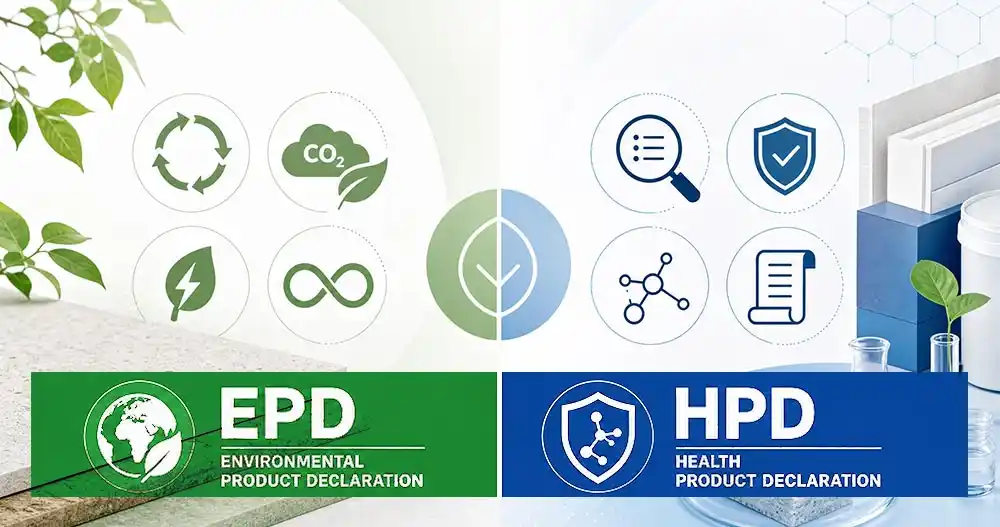
EPD vs HPD at a Glance
| Feature | EPD | HPD |
| Full Name | Environmental Product Declaration | Health Product Declaration |
| Primary Focus | Environmental impact across full life cycle | Human health and chemical ingredients |
| Governing Standard | ISO 14025, EN 15804 | HPD Open Standard |
| Maintained By | Multiple global program operators | HPD Collaborative (HPDC) |
| Third-Party Verification | Required | Optional |
| LEED v4.1 Credit | MR: Environmental Product Declarations | MR: Material Ingredients |
| WELL Certification | No | Yes |
| Cost Range (GCC) | $3,000–$16,000 | $1,000–$5,000 |
| Typical Timeline | 3–6 months | 1–2 months |
| Validity Period | 5 years | Periodic updates |
| GCC Demand | High and growing fast | Growing, project-specific |
What Is an Environmental Product Declaration (EPD)?
An Environmental Product Declaration (EPD) GCC is a document verified by a third party. It shows a product’s environmental impact across its full life cycle. That means from raw material to disposal. An EPD gives real data on carbon, energy, water, and waste.
An EPD is based on a Life Cycle Assessment (LCA). The LCA gathers the environmental data. The EPD then publishes that data in a verified, standard format. An independent expert checks the numbers first.
EPDs follow ISO 14025 and EN 15804 for construction products. You register them with a recognized program operator. These include EPD International, IBU, and UL Environment. GCC green building systems — Estidama, Mostadam, and GSAS — all accept EPDs from these operators.
Key environmental indicators in an EPD include:
- Global Warming Potential (GWP) — carbon footprint
- Depletion of the stratospheric ozone layer
- Acidification of land and water
- Eutrophication
- Depletion of nonrenewable energy resources
EPDs are valid for five years. After that, you must update and re-verify them.
Does an EPD disclose chemical ingredients?
No. EPDs report environmental impacts like carbon, energy, and water. They do not list chemical ingredients. That is what an HPD does.
What Is a Health Product Declaration (HPD)?
A Health Product Declaration (HPD) shows what a product is made of. It lists all chemical ingredients. It also flags any health hazards. The goal is clear: tell people what occupants and workers may be exposed to.
An HPD does not report life cycle impacts. It looks at the product “as delivered to the job site.” So it tells you what is inside the product. It does not tell you how the product performed from cradle to grave.
HPDs follow the HPD Open Standard. The HPD Collaborative (HPDC) builds and maintains this standard. Manufacturers can self-publish an HPD. But they can also add optional third-party verification through the HPDC program. This boosts credibility.
An HPD covers:
- Homogeneous materials and their chemical substances
- Hazard screening results from authoritative bodies
- Certifications and compliance documentation
- Accessories and referenced standards
HPDs support WELL Building Standard features for Materials Transparency and Materials Optimization. In LEED v4.1, they earn points under the MR Credit: Material Ingredients. This is separate from the EPD credit.
Does an HPD measure carbon footprint?
No. HPDs list chemical ingredients and health hazards only. They do not measure carbon footprint or lifecycle environmental impact. You need an EPD for that.
Key Differences Between EPDs and HPDs
Knowing the differences helps you pick the right document for each project.
| Category | EPD | HPD |
| What it reports | Environmental impacts across the life cycle | Chemical ingredients and health hazards |
| When it applies | When a project needs environmental impact data | When a project needs material health disclosure |
| Verification | Mandatory third-party | Optional third-party |
| Publication | Requires a program operator | Can be self-published |
| LEED credit type | MR: Environmental Product Declarations (up to 2 pts) | MR: Material Ingredients (up to 2 pts) |
| WELL credit | Not eligible | Eligible |
| Scope | Full life cycle (cradle-to-gate or cradle-to-grave) | Product as delivered to site |
Which is better — EPD or HPD?
Neither is better — they serve different purposes. An EPD focuses on environmental impacts across a product’s life cycle, while an HPD emphasizes health by disclosing chemical ingredients and potential hazards. Choosing depends on whether your project prioritizes environmental responsibility or occupant health.
EPD vs HPD for LEED Projects
EPDs and HPDs both help earn LEED points but target different credits. EPDs focus on environmental impacts, while HPDs disclose chemical ingredients. Using both can maximize your Material and Resources (MR) credit score, especially in GCC LEED Gold and Platinum projects.
Do EPDs help earn LEED points?
Yes. EPDs contribute to the LEED v4.1 MR Credit: Building Product Disclosure and Optimization – Environmental Product Declarations. Up to 2 points are available. Product-specific EPDs carry more weight than industry-wide EPDs, offering greater credit value.
Do HPDs help earn LEED points?
Yes. HPDs support the LEED v4.1 MR Credit: Building Product Disclosure and Optimization – Material Ingredients. This credit is separate from the EPD credit. HPDs provide transparency by disclosing chemical content and potential health hazards, not environmental impact.
Do I need both EPD and HPD for LEED?
Not always—but having both documents maximizes your MR credit potential. Many GCC LEED Gold and Platinum projects require suppliers to submit both EPDs and HPDs. LEED v5 is increasingly emphasizing the need for comprehensive transparency with both environmental and health data.
Do HPDs help earn LEED points?
Yes. HPDs earn points under MR Credit: Material Ingredients in LEED v4.1. This is a separate credit from EPDs. Both together maximise your MR credit score.
Which building materials need HPDs in GCC?
Materials with chemical content and health concerns like paints, coatings, adhesives, sealants, flooring, carpets, and furniture often need HPDs.
Which Products Need an EPD and Which Need an HPD?
Your product type and project rules drive the choice. Some projects need both.
| Product Type | EPD Needed? | HPD Needed? | Notes |
| Concrete and cement | Yes | Optional | Core EPD product in UAE and KSA |
| Steel and aluminum | Yes | Optional | Required for NEOM and giga-projects |
| Glass and glazing | Yes | Optional | Common for LEED-rated office towers |
| Paints and coatings | Optional | Yes | High chemical ingredient scrutiny |
| Adhesives and sealants | Optional | Yes | WELL and LEED Material Ingredients credit |
| Insulation products | Yes | Yes | Both credits apply frequently |
| Flooring and carpet | Optional | Yes | Material health often project-specified |
| HVAC equipment | Yes | Optional | Embodied carbon data increasingly required |
| Furniture and finishes | Optional | Yes | BIFMA and WELL-driven demand |
Cost and Timeframe for GCC Projects
An EPD in the GCC costs about $3,000 to $16,000. Simple products like concrete blocks cost less. Complex products like HVAC systems cost more.
Cost breakdown for EPD:
- LCA study: $2,000–$8,000
- Third-party verification: $2,000–$5,000
- Program operator registration: $500–$2,000 per year
An HPD costs $1,000 to $5,000. The price depends on how many ingredients you screen. It also depends on whether you add optional third-party verification.
Timeline comparison:
- EPD: 3–6 months (data collection, LCA, verification, registration)
- HPD: 1–2 months (ingredient data gathering, reporting, optional verification)
The EnviroLink sustainability team suggests starting your EPD at least six months before a tender deadline. HPDs can move faster. This is true when you only need the Material Ingredients LEED credit.
Which should you start with — EPD or HPD?
Start with EPD if your clients ask for LEED environmental credits. Start with HPD if they ask about chemical safety or WELL certification. Most GCC manufacturers start with EPD.
Why Manufacturers Need Both — Not Just One
Manufacturers benefit from providing both EPDs and HPDs to meet diverse project needs. Each document addresses different but complementary requirements, helping products qualify for more sustainability certifications and access wider markets.
Architect perspective
Architects specify products based on environmental and health criteria. They rely on EPDs to compare carbon emissions and other environmental impact categories. HPDs are essential for assessing indoor air quality and ensuring compliance with WELL certification standards.
Procurement perspective
Procurement teams, especially for UAE government projects and multinational contractors, rigorously screen suppliers for sustainability documentation. Missing either an EPD or HPD can lead to exclusion from approved supplier lists, affecting business opportunities.
Export market perspective
Export markets demand comprehensive transparency. European buyers require EPDs to comply with CBAM regulations on steel and cement exports, while US buyers prioritize HPDs for LEED and WELL-certified projects. Offering both documents enables manufacturers to enhance sustainability credentials and expand into multiple international markets.
My product has an EPD. Do I still need an HPD?
Yes — an EPD covers only the environmental impact of a product, while an HPD discloses its chemical ingredients and potential health hazards. LEED v4.1 offers separate credits for each, so having both can maximize your project’s sustainability score.
Real GCC Business Scenarios
Scenario 1: Tile Manufacturer in Ras Al Khaimah
A tile maker in Ras Al Khaimah supplies a LEED Gold residential tower in Dubai. The project specification required both EPD and HPD documents.
The manufacturer needed an EPD for the MR: Environmental Product Declarations credit. They also needed an HPD for the MR: Material Ingredients credit. The EPD took five months to complete, while the HPD was ready in six weeks. Together, both documents earned the contractor three additional LEED points and helped the manufacturer remain on the approved supplier list.
Scenario 2: Paint Manufacturer in Dubai
A paint manufacturer in Dubai supplied products for a commercial fitout project targeting LEED v4.1 certification. The project team’s primary concern was chemical transparency and occupant health rather than full life-cycle environmental data.
In this case, an HPD was the right choice. It disclosed all chemical ingredients, identified hazard levels, and satisfied the Material Ingredients credit requirements. An EPD was not necessary for this credit. The manufacturer completed the HPD in two months, avoiding the longer and more expensive EPD process.
These examples show why understanding the difference between EPD and HPD is important. Choosing the correct document can save both time and money on GCC sustainability projects.
Common EPD and HPD Mistakes to Avoid
Avoid these errors before you submit documents on GCC tenders:
- Confusing EPD with HPD. They serve different LEED credits. Submit the wrong document and you may lose the credit.
- Letting an EPD expire mid-project. Some GCC giga-projects require EPDs that are less than three years old, even if the standard five-year validity period has not ended.
- Self-publishing an HPD without verification. Optional third-party verification improves credibility. Projects pursuing WELL certification often prefer verified HPDs.
- Choosing the wrong EPD scope. Cradle-to-gate EPDs may not satisfy all Estidama or LEED requirements. Always review the project credit criteria first.
- Using an unrecognized program operator. Confirm that the operator is accepted by the applicable green building system, such as LEED, Estidama, Mostadam, or GSAS.
- Delaying HPD preparation. HPDs may appear simple, but collecting complete ingredient information from suppliers can take time. Start the process early.
EnviroLink helps manufacturers review project specifications, identify the correct documentation pathway, and avoid costly compliance mistakes before submission.
Are HPDs required in GCC construction projects?
HPDs are not legally mandatory across GCC countries at present. However, LEED v4.1 and emerging LEED v5 projects in the UAE and Saudi Arabia increasingly request HPDs from suppliers. Demand is expected to grow as adoption of the WELL Building Standard expands across the region.
EPD vs HPD: The Short Answer
Choosing the Right Document for Your GCC Business
EPDs and HPDs serve different purposes. They answer different questions, follow different standards, and contribute to different sustainability credits. The right choice depends on your product type, project requirements, and the green building system being used.
Partnering with EnviroLink helps you choose the correct pathway from the beginning. This can save time, reduce costs, and keep your products tender-ready across GCC markets.
Contact EnviroLink today for a free EPD and HPD assessment. Our team responds within 24 hours.
Frequently Asked Questions
What is the main difference between an EPD and an HPD?
An EPD reports a product’s environmental impact across its full life cycle. An HPD reports the chemical ingredients inside a product and identifies potential health hazards. They serve different purposes and contribute to different LEED credits.
Do I need both EPD and HPD?
You may need both depending on your project requirements. Many GCC LEED Gold and Platinum projects use both documents to maximize Material and Resources credit points. EPDs focus on environmental impacts, while HPDs focus on chemical ingredient transparency and occupant health.
Is HPD mandatory in GCC?
HPDs are becoming more common but are not universally mandatory across the GCC. They are often requested for WELL certification and LEED credits related to material ingredients and health-focused building design.
Is EPD mandatory in GCC?
EPDs are increasingly required or strongly encouraged in GCC projects, especially major developments such as NEOM. They are commonly needed for green building certification programs such as LEED, Estidama, and GSAS.
Can a product have both EPD and HPD?
Yes. Many products used in GCC projects have both documents to meet environmental performance requirements and material health transparency standards.
Do EPDs help with LEED certification?
Yes. EPDs contribute to LEED v4.1 MR Credit: Environmental Product Declarations and can help projects earn up to two points under this category.
How long are EPDs valid?
EPDs are typically valid for five years and must be reviewed, updated, and re-verified once they expire.
Are EPDs required in UAE projects?
Yes. EPDs are often required or strongly encouraged in UAE projects pursuing LEED, Estidama, or GSAS certification objectives.


