
GCC manufacturers must now report on their environmental, social, and governance (ESG) performance. EPDs give you verified emissions data. This helps with Scope 3 reporting and CDP requests. This guide shows you what to do and how to start.
ESG reporting is now expected across the GCC. The UAE, Saudi Arabia, Oman, and Bahrain all have rules for listed companies. But even smaller manufacturers feel the pressure. Buyers, banks, and government programs all ask for sustainability data.
The hardest part for manufacturers is the environmental section. Your emissions don’t stop at your factory. They include the materials you buy. They include how your goods are shipped. They include what happens to your products after use.
This guide explains ESG reporting for GCC manufacturers. It shows how EPDs make Scope 3 reporting easier. And it gives you six simple steps to get started.
What Does ESG Reporting Mean for GCC Manufacturers?
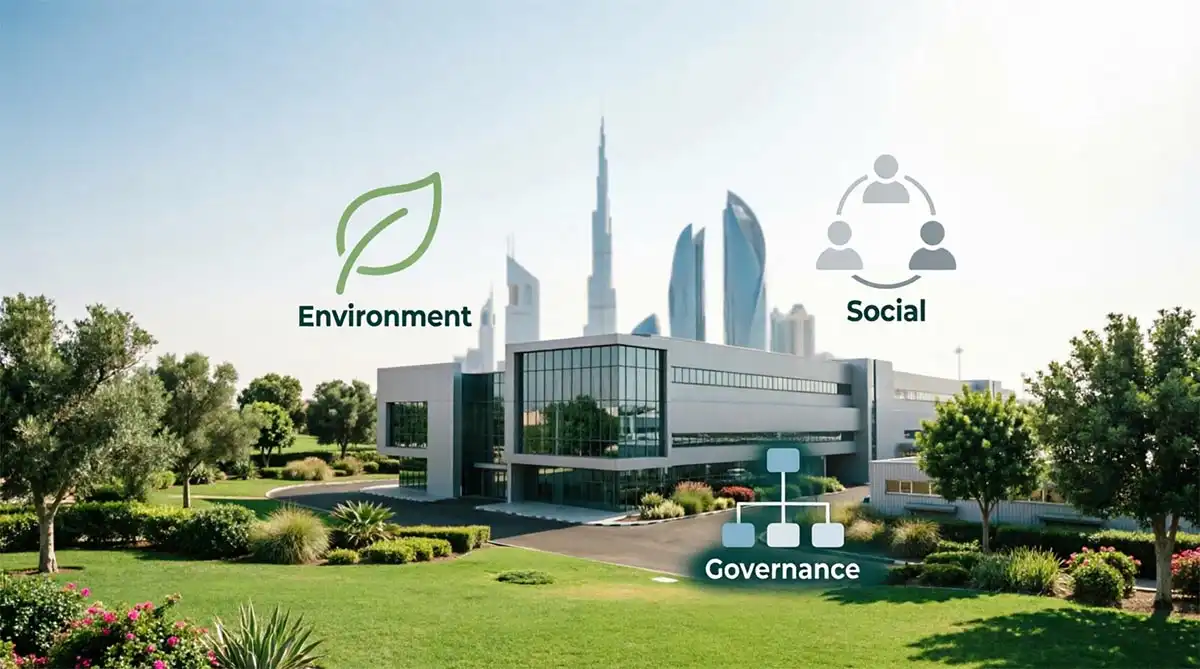
ESG reporting means sharing how your company performs in three areas:
- Environmental — energy use, gas emissions, water use, and waste
- Social — worker safety, training, and labor practices
- Governance — board structure, anti-corruption policies, and risk management
Regulators, buyers, and investors want to know your carbon footprint. That includes emissions you don’t create directly.
Common reporting frameworks used in the GCC include:
- GRI Standards — the most widely used sustainability framework
- TCFD — focuses on climate-related financial risks
- SASB — covers industry-specific metrics
- IFRS S1 and S2 — a global standard now used by GCC regulators
Most manufacturers find Scope 3 emissions the hardest part to report. That is where EPDs help.
What Are Scope 3 Emissions — and Why Do They Matter?
Gas emissions fall into three groups:
- Scope 1 — direct emissions from your own operations, like fuel burned in your factory
- Scope 2 — emissions from the electricity you buy
- Scope 3 — all other indirect emissions linked to your business
Scope 3 covers the materials you buy. It covers how goods are transported. It covers how customers use your products. Supply chain emissions are on average 26 times higher than a company’s direct emissions. Scope 3 is often the largest part of your carbon footprint.
Most companies don’t have good Scope 3 data. GCC rules are getting stricter. That gap is a growing risk. EPDs help close it.
How Do EPDs Provide Scope 3 Data for GCC Manufacturers?
An EPD is a verified document. It shows the full environmental impact of one product. It covers the product from raw materials to the finished good leaving your facility. A qualified third party checks and approves each EPD.
When you share your EPD with a buyer, you give them verified emissions data. They can use it directly in their own Scope 3 reports. Suppliers without EPDs can’t offer this. That puts them at a disadvantage.
What Does an EPD Include?
A standard EPD shows:
- Global Warming Potential (GWP) — carbon emissions per unit of product
- Resource use — energy and water used during production
- Other environmental indicators — such as ozone depletion and acidification
- Functional unit — a standard measure for fair product comparisons
- Life cycle stages — from raw materials through manufacturing and delivery
EPDs are valid for five years. They need at least 12 months of production data. Development takes two to twelve months.
How Do EPDs Connect to CDP Disclosure Requests?
CDP is a global platform for environmental reporting. In 2025, more than 270 major buyers asked around 45,000 suppliers to share environmental data through CDP.
If you supply a global company, they may ask you to disclose through CDP. CDP asks about Scope 1 and Scope 2 emissions. But they increasingly ask about Scope 3 too. A registered EPD lets you respond with verified data — not estimates. This makes you a more trusted supplier.
How Do Vision 2030 and UAE Net Zero 2050 Affect Manufacturers?
Both programs raise ESG expectations for manufacturers.
Saudi Arabia’s Vision 2030 includes the Saudi Green Initiative. It targets a cut of 278 million tonnes of carbon per year by 2030. The Public Investment Fund (PIF) favors businesses with strong ESG performance. Good ESG reporting helps you win government contracts.
The UAE Net Zero 2050 Initiative targets net-zero emissions by 2050. Federal Decree-Law 11 required full GHG reporting compliance by May 30, 2026. Companies that missed the deadline can face fines from AED 50,000 to AED 2 million. If you haven’t set up a reporting system yet, start now.
Bahrain, Oman, Qatar, and Kuwait all have ESG deadlines for 2025 or 2026. Manufacturers who aren’t ready face regulatory and commercial risk.
How to Start ESG Reporting: 6 Steps for GCC Manufacturers
You don’t need to do everything at once. Start simple and build from there.
Step 1: Find Out Which Rules Apply to You
Check if your company is listed on the DFM, ADX, or Tadawul. Ask your key customers if they use CDP or require ESG data. This tells you where to focus first.
Step 2: Run a Materiality Assessment
Find out which ESG topics matter most to your business. For most manufacturers, these include emissions, energy, water, and worker safety. Write down your findings. This is the base of your reporting plan.
Step 3: Set Up ESG Governance
Assign ESG ownership to a senior leader. Give a team responsibility for data collection and reporting. This shows regulators and investors that your ESG program is real — not just paperwork.
Step 4: Build Your Emissions Inventory
Calculate your Scope 1, Scope 2, and key Scope 3 emissions. Use the GHG Protocol as your guide. If you operate in the UAE, use local electricity emission factors. Global averages won’t give you accurate results.
Step 5: Develop EPDs for Your Key Products
Work with a recognized EPD program. Follow these four steps:
- Find the Product Category Rules (PCRs) for your product
- Collect 12 months of operational and purchasing data
- Work with an LCA specialist to build and verify your EPD
- Submit it for third-party review and registration
Buyer demand for EPDs is growing across the GCC. Starting now gives you an advantage over competitors who haven’t started.
Step 6: Choose a Framework and Publish Your Report
Pick a reporting framework. GRI Standards are the most widely used in the GCC. Publish your ESG report every year. Get third-party assurance if you can. Assured reports carry more weight with regulators, buyers, and investors.
ISO 14001 gives manufacturers a structured system to track and report emissions, energy, and waste. It makes ESG reporting and EPD development easier. Envirolink helps manufacturers in the UAE and Saudi Arabia build and certify their environmental management systems. Learn more about ISO 14001 certification here.
Frequently Asked Questions
Is ESG reporting mandatory for manufacturers in the UAE?
It is mandatory for companies listed on the DFM and ADX. Unlisted manufacturers don’t have a formal mandate yet, but buyer and regulatory pressure is growing fast.
What is an EPD and how is it different from an ESG report?
An EPD covers the verified environmental impact of one specific product. An ESG report covers your whole company’s environmental, social, and governance performance.
How long does it take to develop an EPD?
It usually takes two to twelve months. Products with simpler data can move faster.
How do EPDs support CDP disclosure requests?
EPDs give buyers verified emissions data they can use for their own Scope 3 reports. This makes you a more reliable supply chain partner.
Does ISO 14001 help with ESG reporting?
Yes. ISO 14001 gives you structured systems to collect and manage environmental data. This directly supports ESG reporting and EPD development.
How do Vision 2030 and UAE Net Zero 2050 affect unlisted manufacturers?
Both programs raise ESG expectations through procurement rules and supply chain demands. Manufacturers who build compliant systems now will win more contracts and access more financing.


