
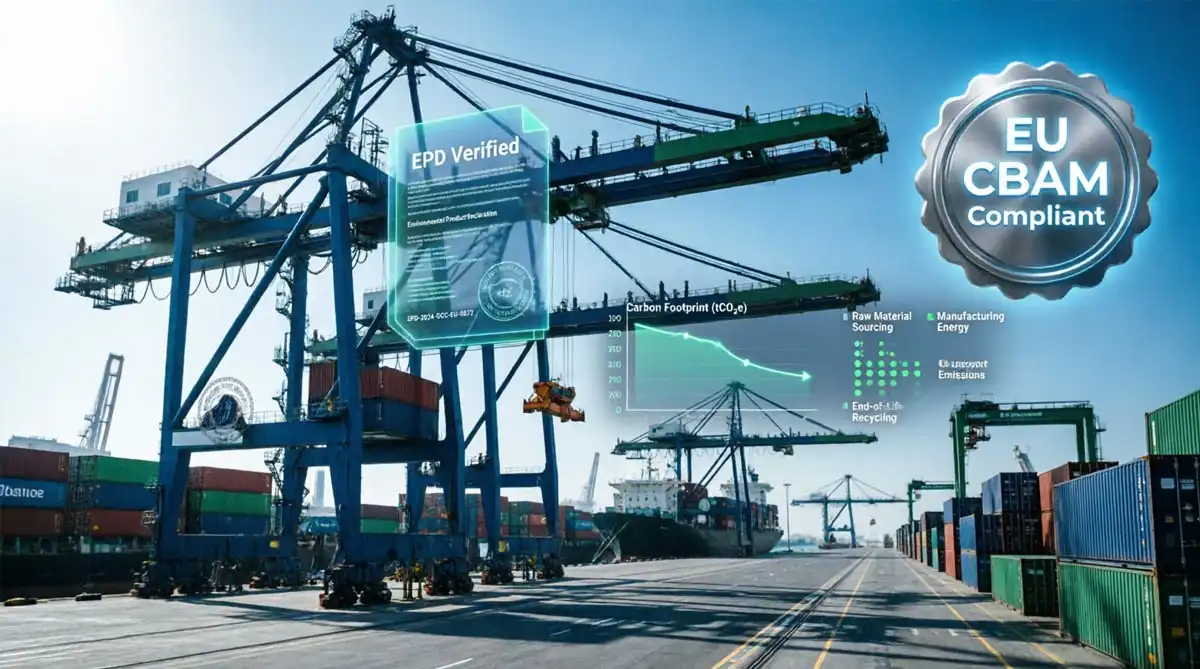
The EU now charges a carbon tax on imports of steel, aluminum, cement, fertilizers, hydrogen, and electricity. This is called CBAM. From January 2026, your EU buyer must pay for the carbon in your product. If you have no verified carbon data, they pay more — and may buy from someone else. An Environmental Product Declaration (EPD) gives them the data they need.
A steel fabricator in Jubail had a ready order for a German buyer. The product was good. The price was right. But the German importer needed verified carbon data for CBAM. The fabricator had none. A Turkish competitor had a verified EPD. They got the contract.
This is happening across the GCC. CBAM is live. If your products go to the EU and you have no verified carbon data, you are at risk right now.
This guide explains what CBAM is, which products it covers, what it costs, and how an EPD solves the problem. EnviroLink works with GCC manufacturers in UAE, Saudi Arabia, Qatar, Kuwait, Oman, and Bahrain to get this done.
What Is CBAM — and Why Does It Affect GCC Exporters?
CBAM is the EU’s carbon tax on imported goods. It started in October 2023. From January 2026, EU buyers must pay for the carbon in every shipment they receive. If you can’t give them verified carbon data, they pay higher default costs — and may stop buying from you.
CBAM stands for Carbon Border Adjustment Mechanism. It is set out in EU Regulation 2023/956.
Here is how it works. The EU charges its own producers for every tonne of CO₂ they emit. CBAM applies the same cost to imports. This stops companies from avoiding EU carbon rules by making goods outside Europe.
For you as a GCC exporter, this means one thing: your EU buyer now has to report the carbon in your product — and pay for it. The less carbon your product has, the less they pay. The more carbon, the more it costs. And if you give them no data at all, the EU uses default values — which are almost always higher than your real emissions.
Full enforcement started January 1, 2026.
Which GCC Products Are Affected by CBAM?
CBAM covers six product groups. If you export steel, aluminum, cement, fertilizers, hydrogen, or electricity to the EU, you are in scope now.
| Product | GCC Countries Most Exposed | Examples |
| Steel and iron | Saudi Arabia, UAE, Qatar | Rebar, pipes, structural steel |
| Aluminum | UAE (EMAL, DUBAL), Bahrain (Alba) | Ingots, billets, rolled products |
| Cement | UAE, Saudi Arabia, Kuwait | Clinker, Portland cement |
| Fertilizers | Saudi Arabia, Qatar | Ammonia, urea, nitric acid |
| Hydrogen | Saudi Arabia, UAE | Green and grey hydrogen |
| Electricity | Limited GCC impact | Cross-border exports |
GCC aluminum and steel exporters face the highest exposure. UAE and Saudi Arabia are among the world’s largest exporters of both.
How Does CBAM Work — and What Does It Cost?
Your EU buyer reports the carbon in your product each quarter. At year end, they buy CBAM certificates to cover it. The certificate price follows the EU carbon market — currently around €50–€70 per tonne of CO₂. If you give them no verified data, they pay based on EU default values, which are set high.
| Product | Typical Embedded Carbon | Estimated CBAM Cost at €60/tCO₂e |
| Primary aluminum | 8–14 tCO₂e per tonne | €480–€840 per tonne |
| Steel (BF-BOF) | 1.8–2.5 tCO₂e per tonne | €108–€150 per tonne |
| Steel (EAF, GCC) | 0.4–0.8 tCO₂e per tonne | €24–€48 per tonne |
| Cement (clinker) | 0.7–0.9 tCO₂e per tonne | €42–€54 per tonne |
| Ammonia | 1.5–2.5 tCO₂e per tonne | €90–€150 per tonne |
| Urea fertilizer | 2.0–3.5 tCO₂e per tonne | €120–€210 per tonne |
Figures are estimates for planning. Actual carbon varies by production method.
Your buyer passes this cost back to you — through lower prices or fewer orders. The solution is simple: give them your real, verified carbon figure. It is almost always lower than the EU default.
What Carbon Data Does CBAM Actually Require?
CBAM needs the total greenhouse gas emissions from making your product — called “embedded emissions.” This covers gases from your production process and, for some products, electricity use. It is measured in tCO₂e per tonne of product.
CBAM looks at what happens from raw materials to your factory gate. This is called cradle-to-gate. It matches the system boundary used in a Life Cycle Assessment (LCA) — the study behind an EPD.
There are three types of embedded emissions CBAM tracks:
- Direct emissions — gases from your production process (burning fuel, chemical reactions)
- Indirect emissions — from electricity you use (required for aluminum and some steel)
- Precursor emissions — carbon in raw materials you buy (e.g., alumina, iron ore pellets)
Verified Data vs Default Values — Why It Matters
| Data Type | Source | Cost to Your Buyer |
| Verified data (EPD or LCA) | Your own production, third-party verified | Lower — reflects your real emissions |
| EU default values | EU Commission estimates | Higher — set above most real-world figures |
GCC aluminum smelters using gas power often emit far less than EU defaults suggest. Using defaults means your buyer overpays — and that cost comes back to you. Verified data from a Life Cycle Assessment published as an EPD solves this.
How EPDs Help GCC Exporters with CBAM Compliance
An Environmental Product Declaration (EPD) is a verified document that shows the carbon in your product. It is based on an ISO 14044 Life Cycle Assessment and checked by an independent expert. It gives your EU buyer the exact carbon figure they need for CBAM — and it replaces expensive default values.
EPDs follow ISO 14025 and are published through accredited EPD program operators like EPD International. The carbon figure in the EPD (Module A1–A3) maps directly to what CBAM requires.
One EPD also works for LEED credits, Estidama compliance, ESG reporting, and EU green procurement. EnviroLink EPD consultants help GCC clients get maximum value from a single EPD across all these requirements.
What Your EU Importer Gets from Your EPD
- A verified carbon figure per tonne of product
- A publicly registered document they can cite in their CBAM filing
- Third-party verification that meets EU standards
- A clear system boundary (cradle-to-gate, A1–A3)
This gives your buyer confidence. It reduces their cost. And it protects your relationship.
EPD vs LCA — Which Do You Need?
| Feature | LCA Report Only | Published EPD |
| Provides carbon data for CBAM | Yes | Yes |
| Third-party verified | Not always | Always |
| Publicly registered | No | Yes |
| Accepted by EU CBAM authorities | Depends | Yes — ISO 14025 compliant |
| Works for LEED, Estidama | No | Yes |
| EPD validity and renewal framework | No | Yes — 5-year validity |
A standalone LCA may work for CBAM in some cases. But a published EPD is more widely accepted, more trusted by EU buyers, and more useful across multiple reporting needs. EnviroLink GCC recommends the EPD route for any exporter with regular EU sales.
CBAM Compliance Timeline — Where GCC Exporters Stand Now
The reporting phase ran from October 2023 to December 2025. Full enforcement — with real financial penalties — started January 1, 2026. If you have not yet secured verified carbon data, you are already exposed.
| Period | CBAM Phase | What You Need to Do |
| Oct 2023 – Dec 2025 | Transitional | Report carbon data to your EU buyer quarterly |
| Jan 2026 onwards | Full enforcement | Your buyer needs verified data to avoid high default costs |
| 2026+ | Possible expansion | More product types may be added — monitor updates |
An EPD takes 8 to 14 weeks to complete from data submission. Add time for data collection and you need to start now. EnviroLink can tell you exactly how long the process will take for your product and facility.
Step-by-Step — How GCC Exporters Get CBAM-Ready with EPDs
There are six steps to get a verified EPD and meet CBAM requirements. EnviroLink manages all six steps for GCC manufacturers.
Step 1 — Check if Your Product Is in Scope
Look at the six CBAM sectors: steel, aluminum, cement, fertilizers, hydrogen, and electricity. If your product fits, you are in scope now.
Step 2 — Ask Your EU Buyer What They Need
Contact your EU importer. Ask what carbon data format they need for their CBAM filing. This tells you exactly what to prepare.
Step 3 — Collect Your Production Data
Gather 12 months of energy bills, raw material records, fuel use, and transport data. Good data makes the LCA faster and cheaper.
Step 4 — Commission a Life Cycle Assessment
Work with a qualified Life Cycle Assessment consultant. They model your product’s cradle-to-gate carbon using your production data. This produces the carbon figure your EPD will show.
Step 5 — Get Third-Party Verification
An independent expert checks your LCA and EPD report. This step is mandatory. Without it, the EPD cannot be published or accepted.
Step 6 — Publish and Share Your EPD
Your EPD is registered with an accredited EPD program operator — such as EPD International. Share the carbon figure and registration number with your EU buyer. They can now file accurate CBAM declarations.
Common CBAM Mistakes GCC Exporters Make
The biggest mistakes are waiting too long, relying on EU default values, and treating CBAM as the buyer’s problem. Here are six to avoid.
- Assuming default values are fine. GCC gas-powered aluminum smelters often have much lower carbon than EU defaults. Using defaults costs your buyer more — and hurts your price.
- Starting too late. An EPD takes 8–14 weeks from data submission. Add data collection time. If you haven’t started, start today.
- Thinking a carbon footprint report is enough. Without third-party verification under ISO 14025, it won’t be accepted as verified CBAM data.
- Missing facility-level tracking. CBAM is product-specific and site-specific. Company-level carbon reports don’t meet the requirement. Track embodied carbon GCC at facility level.
- Skipping EPD validity and renewal. EPDs last five years. Some EU buyers need EPDs under three years old. Plan your renewal from day one.
- Leaving it to your buyer. Your buyer files the CBAM report. But your carbon data decides what they pay. Give them verified data — or they’ll find a supplier who does.
CBAM and EPD — The Short Answer
CBAM requires EU buyers to report and pay for the carbon in goods they import from GCC countries. It covers steel, aluminum, cement, fertilizers, hydrogen, and electricity. Full financial enforcement started in January 2026.
GCC exporters who give their buyers verified carbon data — through a published EPD — pay less and win more orders. Without that data, buyers use EU default values, which are almost always higher.
EnviroLink helps GCC manufacturers get EPD-verified carbon data accepted by EU buyers, from start to finish.
Frequently Asked Questions — CBAM and EPD for GCC Exporters
What is CBAM and when did it start?
CBAM is the EU’s carbon tax on imports. It launched in October 2023 with a reporting-only phase. Full financial enforcement — where buyers must buy carbon certificates — started January 1, 2026. It applies to steel, aluminum, cement, fertilizers, hydrogen, and electricity.
Which GCC products are affected by CBAM?
Steel, aluminum, cement, fertilizers, hydrogen, and electricity. UAE and Saudi Arabia are most exposed due to high export volumes of aluminum and steel to EU markets.
How do EPDs help with CBAM compliance?
An EPD shows the verified carbon in your product. Your EU buyer uses that figure in their CBAM filing. It replaces EU default values — which are almost always higher than your real emissions — and reduces their certificate cost.
What happens if GCC exporters don’t provide verified carbon data?
Your EU buyer uses EU default values. These are set high. Their costs go up. They may lower your price, reduce orders, or switch to a supplier who provides verified data.
How much does CBAM cost GCC aluminum and steel exporters?
At €60 per tonne CO₂e, primary aluminum can cost €480–€840 per tonne in CBAM certificates. BF-BOF steel costs €108–€150 per tonne. EAF steel — common in GCC — is lower at €24–€48. Verified data means you pay based on your real, lower emissions.
Is an LCA enough for CBAM or do I need an EPD?
An LCA may meet the data requirement in some cases. But a published EPD is verified, publicly registered, and more widely trusted by EU buyers. It also works for LEED, Estidama, and ESG reporting. For ongoing EU sales, an EPD is the better choice.
How long does it take to get CBAM-compliant carbon data?
The full process — data collection, LCA, verification, and EPD publication — takes 12 to 22 weeks. The LCA and EPD stages alone take 8 to 14 weeks. Start now to avoid delays before your next EU shipment.


