
Introduction: The Concrete Foundation of UAE's Green Vision
An Environmental Product Declaration (EPD) for concrete is a verified document that tracks the lifecycle carbon footprint of construction materials in the UAE. As the nation accelerates toward its UAE Net Zero 2050 vision, concrete manufacturers face increasing pressure to prove their environmental credentials. The construction sector contributes nearly 40% of global carbon emissions, making transparent environmental data crucial for sustainable infrastructure development.
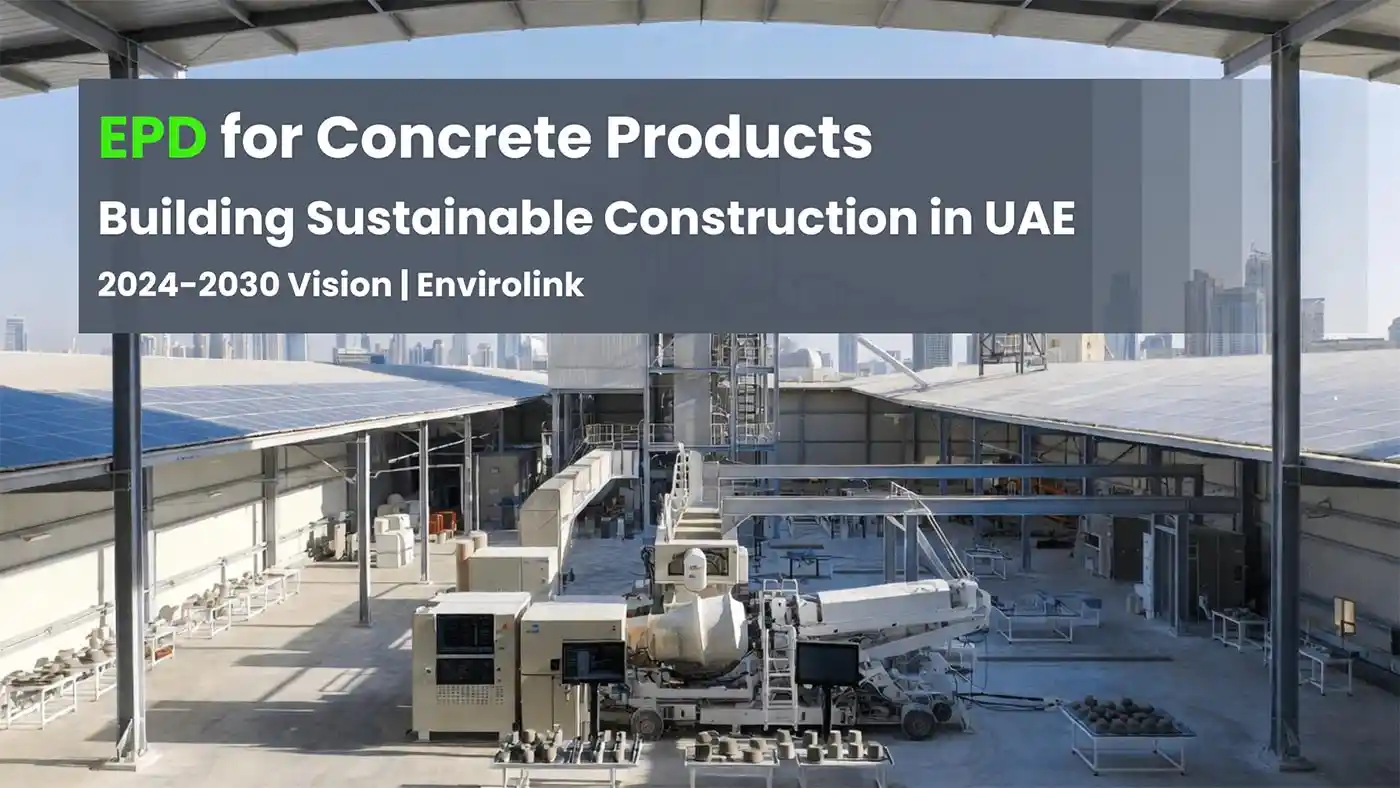
The UAE government’s commitment to decarbonization has transformed how builders, contractors, and material suppliers approach construction projects. From Dubai’s ambitious green building initiatives to Abu Dhabi’s stringent Estidama requirements, environmental accountability is no longer optional—it’s essential. EPD for concrete UAE projects provides the transparency needed to meet these evolving standards while maintaining competitive advantages in a rapidly changing market.
Did you know? The concrete industry alone accounts for approximately 8% of global CO2 emissions, which is why verified environmental data through EPDs has become a game-changer for sustainable construction in the Middle East.
Why Concrete is at the Heart of the UAE's Sustainability Challenge
Concrete remains the most widely used construction material across the UAE, from residential towers in Dubai Marina to infrastructure projects along Sheikh Zayed Road. However, traditional concrete production generates significant carbon emissions through cement manufacturing, the primary binding agent. Each ton of cement produces roughly 0.9 tons of CO2, creating an urgent need for low carbon concrete Dubai alternatives.
The UAE’s construction boom continues unabated, with mega-projects like NEOM’s cross-border initiatives and Expo City Dubai requiring millions of cubic meters of concrete annually. This creates both a challenge and an opportunity: how can manufacturers meet massive demand while reducing environmental impact? The answer lies in transparent environmental reporting through standardized tools like Environmental Product Declarations.
Transitioning to sustainable construction practices requires more than good intentions. It demands verified data, third-party validation, and compliance with international standards. This is precisely where EPDs provide measurable value, offering concrete proof of environmental performance improvements.
What is an EPD? The 'Environmental Nutrition Label' for Concrete
Think of an Environmental Product Declaration as a nutrition label for building materials. Just as food labels disclose calories, ingredients, and nutritional content, EPDs reveal the environmental impact of construction products throughout their lifecycle. For concrete manufacturers, this means documenting everything from raw material extraction to production, transportation, and eventual disposal or recycling.
EPDs follow strict international standards, primarily ISO 14025 and EN 15804 standards, ensuring consistency and comparability across different products and manufacturers. Third-party verification by accredited organizations guarantees the accuracy and credibility of reported data. This standardization allows architects, contractors, and project developers to make informed comparisons between different concrete suppliers based on objective environmental criteria.
The documentation includes critical metrics such as Global Warming Potential (GWP), water consumption, acidification potential, and resource depletion. These quantifiable indicators help stakeholders understand the true environmental cost of their material choices, moving beyond greenwashing toward genuine sustainability.
The Technical Trio: Understanding the Difference Between EPD, LCA, and HPD
Navigating the alphabet soup of environmental certifications can confuse even experienced construction professionals. Three key documentation types dominate sustainable building discussions: EPD, LCA, and HPD. Understanding their distinct purposes helps manufacturers choose the right path for their business objectives.
A Life Cycle Assessment (LCA) is the foundational research that quantifies environmental impacts across a product’s entire lifecycle. It’s the detailed scientific study that generates the data. An EPD takes this LCA data and presents it in a standardized, publicly available format that’s been independently verified. Meanwhile, a Health Product Declaration (HPD) focuses specifically on chemical ingredients and their potential health impacts rather than environmental metrics. For more clarity on these differences, explore our detailed guide on EPD vs LCA.
Most concrete manufacturers in the UAE begin with an LCA to understand their environmental baseline. This assessment identifies hotspots where emissions reduction efforts will have the greatest impact. The LCA then forms the backbone of the EPD, which becomes the public-facing document used in green building certification applications and procurement processes.
EPDs in UAE Green Building Standards (Estidama & Dubai Green Building Code)
The UAE has established two primary green building frameworks that increasingly require EPDs for construction materials. Abu Dhabi’s Estidama Pearl Rating system and the Dubai Green Building Regulations both recognize EPDs as valuable documentation for achieving sustainability credits and compliance.
Estidama’s framework awards points for using materials with verified environmental declarations. Projects seeking higher Pearl ratings—whether 1 Pearl for basic compliance or the prestigious 5 Pearl rating—benefit significantly from specifying EPD-certified concrete. Similarly, Dubai’s green building code encourages transparency in material sourcing and environmental impact reporting, creating market advantages for manufacturers who invest in EPD certification.
Beyond regulatory compliance, these frameworks drive market differentiation. Contractors bidding on government projects or high-profile developments increasingly face requirements to use certified sustainable materials. Having an EPD ready positions concrete suppliers to capture these premium opportunities while competitors struggle with documentation gaps. Understanding LEED EPD certification requirements helps manufacturers prepare comprehensive documentation.
How EPDs Provide Transparent Data for Global Green Certifications (LEED & BREEAM)
International green building certifications like LEED (Leadership in Energy and Environmental Design) and BREEAM (Building Research Establishment Environmental Assessment Method) have become global benchmarks for sustainable construction. Both systems award valuable credits for using materials with EPDs, directly influencing project certification levels and market value.
Did you know? LEED v4 and v4.1 specifically reward projects that use products with EPDs through the Materials and Resources credits, potentially contributing up to 4 points toward certification.
LEED’s Material Ingredients credit explicitly values EPDs and HPDs, rewarding projects that demonstrate transparency in material composition and environmental impact. For concrete suppliers, this means that providing EPDs can make your products significantly more attractive to project teams pursuing LEED Gold or Platinum certification. The U.S. Green Building Council maintains comprehensive resources on how EPDs contribute to point achievement.
BREEAM similarly recognizes EPDs under its Materials category, particularly within assessments conducted across the Middle East. As international developers bring global sustainability standards to UAE projects, having readily available EPDs becomes a competitive necessity rather than a nice-to-have advantage.
Reducing the Carbon Footprint of Precast and Ready-Mix Concrete
The journey toward low carbon concrete involves multiple strategies, from reformulating mix designs to optimizing production processes. EPDs provide the measurement framework that makes carbon reduction efforts visible and verifiable, transforming sustainability from abstract goals into concrete achievements.

The journey toward low carbon concrete involves multiple strategies, from reformulating mix designs to optimizing production processes. EPDs provide the measurement framework that makes carbon reduction efforts visible and verifiable, transforming sustainability from abstract goals into concrete achievements.
Progressive concrete manufacturers in the UAE are implementing several proven strategies. Substituting traditional Portland cement with supplementary cementitious materials like fly ash, slag, or silica fume significantly reduces embodied carbon. Optimizing aggregate sourcing to minimize transportation distances cuts both costs and emissions. Advanced curing techniques and waste heat recovery further improve environmental performance across both ready-mix concrete and precast operations.
The EPD process itself often reveals unexpected opportunities for improvement. The detailed cradle-to-gate environmental impact analysis required for EPD development highlights specific production stages where interventions deliver maximum benefit. Many manufacturers discover that relatively simple operational changes—improved logistics, equipment upgrades, or material substitutions—can dramatically reduce their carbon footprint while maintaining or even improving product quality.
Navigating EPD Compliance: How Envirolink Empowers UAE Manufacturers
Obtaining an EPD involves navigating complex technical requirements, from conducting comprehensive LCAs to securing third-party verification. For many concrete manufacturers, particularly smaller operations, this process appears daunting. However, partnering with experienced sustainability consultants streamlines the journey significantly.
Envirolink specializes in guiding UAE manufacturers through every stage of EPD development and verification. Our team handles the technical heavy lifting—data collection, LCA modeling, documentation preparation, and coordination with accredited verification bodies. This allows manufacturers to focus on their core business while ensuring their environmental credentials meet international standards. Learn more about our comprehensive sustainability solutions.
The process typically begins with a detailed assessment of current production methods and data availability. We help manufacturers identify gaps, implement necessary measurement systems, and compile the evidence required for robust EPD creation. Our experience with regional manufacturing contexts—from material sourcing patterns to energy grid characteristics—ensures accuracy while accelerating timelines. For those new to environmental certifications, our EPD guide for businesses provides an excellent starting point.
Actionable Strategy: Practical Steps to Obtain Your EPD Certification
Ready to pursue EPD certification for your concrete products? Follow this structured approach to navigate the process efficiently:
Step 1: Conduct a Product Screening – Identify which concrete products in your portfolio would benefit most from EPD certification. Focus on high-volume products or those frequently specified in green building projects.
Step 2: Perform a Life Cycle Assessment – Work with qualified LCA practitioners to quantify your product’s environmental impacts. This involves collecting detailed production data, including energy consumption, raw material inputs, water usage, and emissions. Discover more about lifecycle assessment processes.
Step 3: Select a Program Operator – Choose an EPD program operator that aligns with your target markets. Options include EPD International, IBU (Institut Bauen und Umwelt), or regional programs recognized in your key markets.
Step 4: Prepare EPD Documentation – Compile all required information following your selected program’s Product Category Rules (PCR). These rules ensure consistency and comparability within concrete product categories.
Step 5: Third-Party Verification – Submit your EPD draft to an accredited verifier who will review your data, methodology, and conclusions for accuracy and compliance with standards.
Step 6: Publication and Registration – Once verified, your EPD gets published in the program operator’s database, making it accessible to specifiers, architects, and contractors worldwide.
Step 7: Ongoing Maintenance – EPDs typically remain valid for five years, requiring periodic updates to reflect process improvements or changes in production methods. This ensures your environmental data stays current and credible.
Key Takeaway
Environmental Product Declarations represent more than regulatory compliance—they’re strategic business tools that open doors to premium projects, differentiate your products in competitive markets, and demonstrate genuine commitment to the UAE’s sustainability vision. As green building requirements tighten and environmental scrutiny intensifies, manufacturers with verified EPDs will lead the next generation of sustainable construction materials UAE development.
Conclusion: Building a Greener Future with Envirolink
The transformation of UAE’s construction sector toward sustainability creates unprecedented opportunities for forward-thinking concrete manufacturers. EPDs provide the verified environmental credentials that unlock access to green building projects, satisfy increasingly sophisticated customers, and align your business with national decarbonization goals.
Envirolink stands ready to guide you through this transition. Our expertise in EPD certification, combined with deep understanding of regional construction markets and international standards, ensures your environmental documentation meets the highest benchmarks. Whether you’re producing ready-mix concrete for residential projects or specialized precast elements for infrastructure developments, we tailor our approach to your specific needs and business objectives.
The journey toward sustainable construction begins with transparent environmental data. Start building your competitive advantage today by exploring how EPDs can transform your product positioning and market access. For manufacturers across the GCC region, our comprehensive EPD guide provides essential insights for getting started.
Glossary: Essential EPD & Sustainability Terms
1. Environmental Product Declaration (EPD): A standardized, third-party verified document that communicates the environmental performance of a product throughout its lifecycle, following international standards like ISO 14025.
2. Life Cycle Assessment (LCA): A comprehensive analysis method that evaluates the environmental impacts of a product from raw material extraction through production, use, and end-of-life disposal (cradle-to-grave) or to factory gate (cradle-to-gate).
3. Global Warming Potential (GWP): A metric that measures the total greenhouse gas emissions associated with a product, expressed in kilograms of CO2 equivalents. This is the primary indicator for a product’s carbon footprint.
4. Cradle-to-Gate: A lifecycle assessment boundary that measures environmental impacts from raw material extraction through manufacturing and delivery to the factory gate, excluding use phase and disposal.
5. Product Category Rules (PCR): Specific guidelines that ensure EPDs for similar products follow consistent methodologies, making environmental comparisons meaningful and reliable across different manufacturers.
6. Embodied Carbon: The total greenhouse gas emissions generated during the extraction, manufacturing, transportation, and installation of a building material, excluding operational emissions during use.
7. Supplementary Cementitious Materials (SCMs): Alternative materials like fly ash, slag, or silica fume that partially replace Portland cement in concrete mixes, significantly reducing carbon emissions while maintaining or improving performance.
8. Third-Party Verification: Independent review by an accredited organization to validate that EPD data, methodology, and calculations comply with relevant standards and accurately represent the product’s environmental performance.
9. ISO 14025: The international standard that establishes principles and procedures for developing Type III environmental declarations (EPDs), ensuring consistency and credibility across different products and regions.
10. Decarbonization: The process of reducing carbon dioxide emissions associated with production, construction, and operations, typically through energy efficiency, material substitution, renewable energy adoption, and process optimization.
Frequently Asked Questions
An EPD for concrete is a standardized, third-party verified document that communicates the environmental performance of concrete products throughout their lifecycle. In the UAE, EPDs are increasingly needed to comply with green building standards like Estidama and Dubai Green Building Code, to achieve LEED or BREEAM certification, and to demonstrate alignment with the nation’s Net Zero 2050 goals. They provide transparent, comparable data that helps architects, contractors, and developers make informed sustainable material choices.
EPDs contribute directly to LEED’s Materials and Resources credits, particularly the Building Product Disclosure and Optimization credits. Projects can earn points by using products with EPDs, which demonstrate environmental transparency. Similarly, BREEAM awards credits under its Materials category for products with verified environmental declarations. Using EPD-certified concrete can help projects achieve higher certification levels—Gold, Platinum, or Excellent ratings—which increase building value and marketability.
A Life Cycle Assessment (LCA) is the detailed scientific study that quantifies environmental impacts across a product’s lifecycle—from raw material extraction through production, use, and disposal. An EPD takes the data generated from an LCA and presents it in a standardized, publicly accessible format following international standards like ISO 14025. Think of the LCA as the research and the EPD as the published, verified report that makes that research useful for decision-makers.
Currently, EPDs are not strictly mandatory for all construction projects in Dubai and Abu Dhabi. However, they are strongly encouraged and often required for projects seeking green building certifications like Estidama Pearl Ratings or Dubai Green Building compliance. Government projects and developments targeting premium sustainability certifications increasingly specify EPD-certified materials in their procurement requirements, making them functionally necessary for many high-profile projects.
A concrete EPD is typically valid for five years from the date of publication. After this period, manufacturers must update and reverify their EPD to ensure the environmental data reflects current production processes, material sourcing, and any improvements made. Some program operators may have slightly different validity periods, but five years is the industry standard. Regular updates also allow manufacturers to demonstrate continuous environmental performance improvements.
Yes, small-scale concrete manufacturers can absolutely obtain EPDs. While the process requires investment in data collection, LCA modeling, and third-party verification, specialized consultants like Envirolink help streamline the process for operations of all sizes. Industry-average EPDs or sector-specific EPDs can sometimes be used as stepping stones before developing product-specific declarations. The key is having accurate production data and commitment to the verification process.
The initial cost of developing an EPD involves fees for LCA studies, program registration, and third-party verification, typically ranging from a few thousand to tens of thousands of dirhams depending on product complexity. However, this cost is generally spread across large production volumes, resulting in minimal per-unit price increases. More importantly, EPDs often reveal cost-saving opportunities through process optimization and can command premium pricing in green building markets, making them a net positive investment for most manufacturers.

