
Introduction
The construction industry is experiencing a green steel revolution. While most builders focused on reducing energy use during a building’s operation, experts now understand that embodied carbon—the emissions from making construction materials—represents a huge part of a building’s total environmental impact. An EPD for steel is becoming the essential tool that architects, engineers, and developers need to measure and reduce this hidden carbon footprint.
An Environmental Product Declaration (EPD) is a verified document that clearly shows a product’s environmental impact throughout its life cycle. Think of it as a detailed report card that tells you exactly how much carbon dioxide, energy, and resources went into making that steel beam or rebar. For construction professionals working on modern projects, understanding EPDs isn’t just good practice—it’s becoming a requirement for green building certifications like LEED v4.1, meeting carbon reduction goals, and winning competitive bids on sustainable projects.
What is an EPD for Steel and Why Does it Matter?
Imagine walking into a grocery store where none of the food packages had nutrition labels. You’d have no idea what you’re really buying or eating. That’s exactly how the construction industry worked until recently when it came to understanding the environmental impact of building materials.
An EPD works like a nutrition label for steel products. It provides standardized, third-party verified information about the environmental footprint of steel production. This means you can actually compare steel from different suppliers on an apples-to-apples basis. One supplier might claim their steel is “green,” but without an EPD, there’s no way to verify that claim or compare it to competitors.
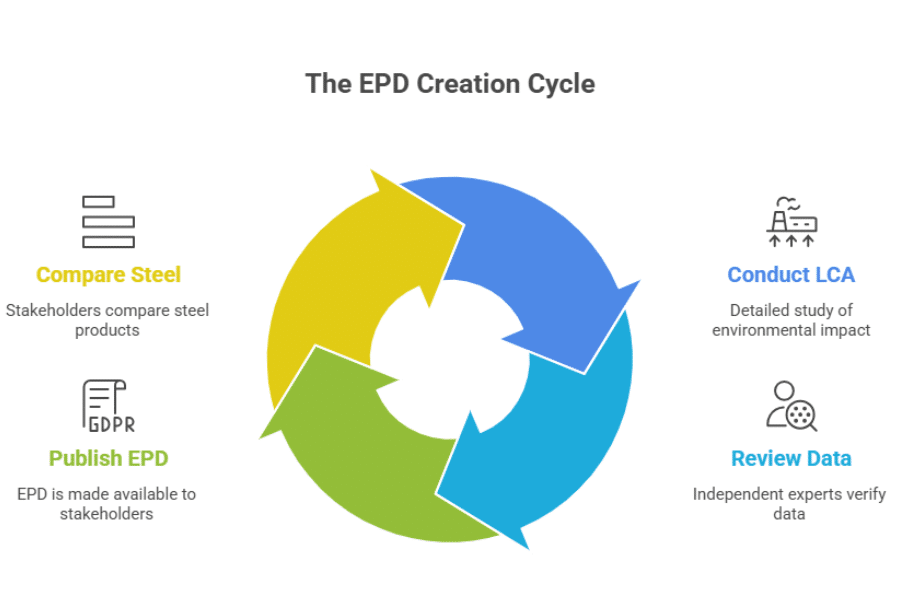
Behind every EPD sits a Life Cycle Assessment, or LCA. This detailed study tracks the environmental impact of steel from raw material extraction through manufacturing. The LCA examines everything: mining iron ore, transporting materials, operating furnaces, shaping the final product, and even the energy sources powering each step. Independent experts then review this data before publishing it as an EPD, giving you confidence that the numbers are real and reliable.
The Business Case: Why Architects and Engineers Demand Steel EPDs
Smart construction professionals aren’t asking for EPDs because they’re environmental activists. They’re asking because EPDs solve real business problems and open up valuable opportunities. Let’s look at the concrete reasons why these documents have become must-haves for modern projects.
Earning Green Building Certifications (LEED, BREEAM, DGNB)
Green building certifications have evolved beyond just solar panels and efficient HVAC systems. Under LEED v4.1, projects can earn critical points in the Materials and Resources category by selecting products with EPDs. Specifically, using steel with product-specific EPDs contributes to credits like “Building Product Disclosure and Optimization – Environmental Product Declarations.”
These aren’t minor bonus points. For many projects, material selection credits make the difference between achieving certification or falling short. BREEAM and DGNB follow similar approaches in Europe, rewarding projects that use materials with transparent environmental reporting. Real estate developers have discovered that buildings with these certifications command higher rents, attract better tenants, and maintain stronger property values over time.
Meeting "Buy Clean" Acts and Government Regulations
Governments worldwide are moving beyond voluntary green building programs to mandatory requirements. California’s Buy Clean Act, passed in 2017, requires state-funded projects to consider the embodied carbon of structural steel and other materials. Similar laws have emerged in Colorado, Washington, and other states, with federal legislation gaining momentum.
The European Union has pushed even further with policies requiring environmental transparency for construction products sold in member countries. These regulations don’t just ask for any environmental claim—they specifically require EPDs that follow international standards. Without proper EPDs for your steel, your project might not qualify for public funding or could face penalties under these decarbonizing steel initiatives.
Risk Mitigation and Future-Proofing
Today’s investment in EPD-backed steel protects tomorrow’s project value. As carbon pricing mechanisms spread globally, buildings with high embodied carbon could face future taxes or retrofit requirements. Major corporations have set aggressive ESG goals, and many now refuse to lease space in buildings that don’t meet environmental standards.
By choosing steel with verified low embodied carbon today, you’re essentially buying insurance against future regulations and market shifts. When carbon taxes arrive or certification requirements tighten, your building is already compliant. That foresight protects your client’s investment and your reputation as a forward-thinking professional.
Key Metrics to Look for in a Steel EPD
Opening an EPD for the first time can feel overwhelming. The document contains numerous environmental indicators and technical terms. However, a few key metrics tell you most of what you need to know about that steel’s environmental performance.

Global Warming Potential (GWP) is the star of the show. Measured in kilograms of carbon dioxide equivalent (kg CO₂e), this number tells you how much greenhouse gas was emitted to produce one unit of steel. When people talk about embodied carbon in construction, they’re primarily referring to GWP. A lower GWP number means less climate impact. For structural steel, you might see numbers ranging from under 500 kg CO₂e per ton for efficient electric arc furnace production up to over 2,000 kg CO₂e per ton for traditional blast furnace routes.
Energy Use appears as “Total Primary Energy Resources” in EPDs. This metric captures both renewable and non-renewable energy consumed during production. While closely related to GWP, energy use provides additional insight into resource efficiency. Some production methods might use lots of energy but rely on renewable sources, resulting in lower GWP.
Recycled Content makes a massive difference in steel’s environmental footprint. Steel produced in Electric Arc Furnaces (EAF) typically contains 90% or more recycled scrap metal. This process uses dramatically less energy and produces far less carbon than making steel from virgin iron ore in traditional Blast Furnace-Basic Oxygen Furnace (BF-BOF) operations. Understanding the production route helps you identify opportunities for specifying sustainable steel procurement on your projects.
How to Compare Steel EPDs (The Pro Tips)
Not all EPDs are created equal. Two steel suppliers might both provide EPDs, but comparing them requires understanding some important technical details. These insider tips will help you make accurate comparisons and avoid common mistakes.
Cradle-to-Gate vs. Cradle-to-Grave
The “system boundary” defines which life cycle stages an EPD includes. Most steel EPDs use a “cradle-to-gate” boundary, meaning they account for impacts from raw material extraction through the factory gate when the product leaves the manufacturing facility. This boundary works well for comparing different steel suppliers since it captures the production phase where manufacturers have direct control.
Some EPDs extend to “cradle-to-grave,” including transportation, installation, building use, and end-of-life recycling. While more comprehensive, these extended boundaries make fair comparisons harder because transportation distances and installation methods vary by project. When comparing EPDs, always check that you’re looking at the same system boundary. Comparing a cradle-to-gate EPD from one supplier against a cradle-to-grave EPD from another is like comparing apples to oranges.
Industry-Wide vs. Product-Specific EPDs
Industry-wide EPDs report average data across multiple manufacturers or an entire industry sector. These generic EPDs provide baseline information but don’t reflect any specific manufacturer’s performance. Product-specific EPDs, in contrast, report data for a particular company’s actual production process at specific facilities.
For carbon accounting and green building credits, product-specific EPDs carry much more weight. They allow you to reward manufacturers who have invested in cleaner production methods. Many leading steel producers now publish facility-specific EPDs showing performance at individual mills. These documents give you the most accurate data for calculating your project’s actual embodied carbon footprint. When you see significantly different GWP numbers between suppliers, you’re often looking at the difference between efficient modern facilities and older, less efficient operations.
The Future of Steel: Beyond the Document
EPDs document today’s steel production, but they’ll also track tomorrow’s revolution in sustainable steel procurement. The steel industry is undergoing its biggest transformation in over a century, and EPDs will serve as the scoreboard for this transition.
Several pioneering companies are now producing “green steel” using hydrogen instead of coal in the reduction process. This innovation could cut steel production emissions by up to 95%. Sweden’s SSAB delivered the world’s first fossil-free steel in 2021, and other major producers are building similar facilities. As these technologies scale up over the next decade, EPDs will document the dramatic improvements in GWP numbers.
We’re also seeing the emergence of digital EPDs with real-time data tracking. Instead of static PDF documents updated every few years, future EPDs might connect to a manufacturer’s production systems, showing current environmental performance. Blockchain technology could verify the chain of custody, ensuring that the low-carbon steel certified in the EPD is actually the steel delivered to your construction site.
The conversation is expanding beyond just carbon. Future EPDs will likely emphasize water use, air quality impacts, and circular economy principles. As the construction industry embraces Life Cycle Assessment thinking more broadly, EPDs will evolve to provide even more comprehensive environmental information.
Key Takeaways
EPDs for steel have shifted from optional documentation to essential tools for modern construction projects. These verified environmental reports enable fair comparisons between suppliers, help earn valuable green building credits, and ensure compliance with growing government regulations around embodied carbon.
When reviewing steel EPDs, focus on Global Warming Potential as your primary metric, understand whether you’re looking at cradle-to-gate or cradle-to-grave boundaries, and prioritize product-specific over industry-average data. The production route—especially whether steel comes from electric arc furnaces using recycled content—makes an enormous difference in environmental impact.
Smart professionals recognize that specifying EPD-backed steel isn’t just about sustainability—it’s about risk management and future-proofing investments. As carbon regulations tighten and green steel technologies mature, the transparency provided by EPDs will only become more valuable. In today’s construction market, EPDs aren’t a nice-to-have credential; they’re a license to operate and compete effectively.
Glossary of Terms
- Embodied Carbon
- The total greenhouse gas emissions generated throughout a material’s life cycle, from extracting raw materials through manufacturing, transportation, and installation. For construction materials like steel, embodied carbon represents the climate impact before the building even opens, as opposed to operational carbon from energy use during the building’s lifetime.
- Life Cycle Assessment (LCA)
- A comprehensive analysis that evaluates the environmental impacts of a product throughout its entire life cycle. An LCA examines resource extraction, manufacturing, distribution, use, and disposal or recycling. The data from an LCA forms the foundation for creating an Environmental Product Declaration.
- Global Warming Potential (GWP)
- A metric that measures the total greenhouse gas emissions associated with a product, expressed as kilograms of carbon dioxide equivalent (kg CO₂e). GWP converts all greenhouse gases to a common unit based on their warming impact relative to CO₂. This is the primary metric used when discussing embodied carbon in construction materials.
- Cradle-to-Gate
- A system boundary in Life Cycle Assessment that includes all environmental impacts from raw material extraction through the point when the finished product leaves the factory gate. This is the most common boundary for steel EPDs because it captures the manufacturing phase where producers have direct control over environmental performance.
- Electric Arc Furnace (EAF)
- A steelmaking method that melts recycled steel scrap using electricity. EAF production typically requires less energy and produces significantly lower carbon emissions compared to making steel from virgin iron ore. Modern EAF facilities can produce steel with 90% or higher recycled content.
- Blast Furnace-Basic Oxygen Furnace (BF-BOF)
- The traditional steel production route that converts iron ore into steel using coal or coke as the primary fuel and reducing agent. While BF-BOF can produce high-quality steel, this process typically generates 2-3 times more carbon emissions per ton than EAF production using recycled scrap.
- Buy Clean Act
- Legislation that requires public projects to prioritize materials with lower embodied carbon. California passed the first Buy Clean Act in 2017, requiring state-funded projects to purchase eligible materials (including steel) that meet maximum limits for Global Warming Potential. Several other states have since adopted similar legislation.
- LEED (Leadership in Energy and Environmental Design)
- The most widely used green building certification system worldwide, developed by the U.S. Green Building Council. LEED v4.1 includes credits specifically for using products with Environmental Product Declarations, making EPDs valuable for projects pursuing LEED certification.
- Product-Specific EPD
- An Environmental Product Declaration based on data from a specific manufacturer’s actual production process at identified facilities. Product-specific EPDs provide more accurate environmental information than industry-average EPDs and carry more weight for carbon accounting and green building credits.
- Third-Party Verification
- An independent review process where qualified experts examine the Life Cycle Assessment data and EPD before publication to ensure accuracy and compliance with international standards. This verification provides confidence that the environmental claims in an EPD are reliable and not just marketing statements.
Frequently Asked Questions
The cost varies based on whether you’re creating an industry-wide or product-specific EPD. Industry associations might spend $50,000 – $100,000 developing a sector-wide EPD that covers multiple manufacturers. Individual companies creating product-specific EPDs typically invest $15,000 – $40,000 per EPD, including the Life Cycle Assessment, third-party verification, and registration. Larger manufacturers often create multiple EPDs covering different product lines or facilities.
EPDs aren’t universally mandatory, but they’re increasingly required for specific project types. Government-funded projects in states with Buy Clean legislation require EPDs for certain materials including steel. Projects pursuing LEED, BREEAM, or similar green building certifications need EPDs to earn materials-related credits. Many large private developers also require EPDs as part of their corporate sustainability commitments, even when not legally mandated.
Most EPDs remain valid for five years from their publication date. After five years, the EPD must be updated with new data and re-verified to ensure the information remains current. Some manufacturers update their EPDs more frequently, especially when they make significant production improvements that lower their environmental impact. Always check the publication date and validity period listed on the EPD.
No, you cannot substitute EPDs between different manufacturers or products. Each EPD represents the specific environmental performance of a particular product or facility. Using one supplier’s EPD to represent another supplier’s steel would misrepresent your project’s actual embodied carbon. For accurate carbon accounting and legitimate green building credits, you must use the EPD from the actual steel supplier providing materials to your project.
An EPD follows strict international standards (ISO 14025 and EN 15804 for construction products) and covers multiple environmental impacts including carbon emissions, energy use, water consumption, and more. A carbon footprint report typically focuses only on greenhouse gas emissions. EPDs must be verified by independent third parties and registered in official databases. Carbon footprint reports, while useful, don’t always follow standardized methodologies or require independent verification.
Yes, absolutely. Steel made primarily from recycled scrap in Electric Arc Furnaces typically shows dramatically lower Global Warming Potential than steel made from virgin iron ore in Blast Furnace operations. The EPD will reflect these differences. A product-specific EPD from an EAF producer might show GWP numbers 60-70% lower than a BF-BOF producer. This is why understanding the production route and reviewing the actual EPD data matters so much for sustainable steel procurement.
EPDs are published in several online databases. In North America, check the Environdec database (international EPD registry) or the EC3 tool (Embodied Carbon in Construction Calculator) which aggregates EPDs from multiple sources. European projects can use the EPD Hub or national databases like the German IBU. Many steel manufacturers also publish their EPDs directly on their websites. Always verify that the EPD is current (within its five-year validity period) and comes from a recognized program operator.


