
Building Life Cycle Assessment (LCA) in the GCC
In the rapidly growing GCC region, sustainable building practices are increasingly vital. Countries like the UAE, Saudi Arabia, Oman, Qatar, and Bahrain invest heavily in green construction to meet environmental goals and reduce carbon footprints. Building Life Cycle Assessment (LCA) helps evaluate environmental impacts across all stages of a building’s life cycle. LCA covers raw material extraction to final disposal, ensuring a comprehensive analysis. International organizations such as the Environmental Protection Agency promote LCA and sustainability standards to guide industry best practices.
LCA assesses energy production and consumption at each building life cycle stage, aiding sustainable energy use and efficiency improvements. It provides insights for architects, engineers, and developers to design energy-efficient buildings aligned with GCC priorities.
Key Takeaways
-
Building LCA offers a complete evaluation of environmental impacts, including energy use, greenhouse gas emissions, and resource depletion.
-
Early LCA integration supports informed design decisions that reduce environmental consequences.
-
Streamlined LCA methods simplify data collection and speed assessments for complex projects.
-
LCA supports green certifications like LEED and Environmental Product Declarations (EPDs).
-
Understanding all building life cycle phases is essential for accurate impact analysis.
What is Building Life Cycle Assessment (LCA)?
Building Life Cycle Assessment (LCA) is a standardized method to evaluate environmental impacts of a building throughout its life cycle, following ISO 14040 and ISO 14044 standards. It assesses all stages from raw material extraction to disposal, providing a comprehensive view of a building’s environmental footprint.
The Five Stages of a Building’s Life Cycle
A building’s life cycle includes all stages from raw material extraction to demolition and recycling. In the GCC, understanding these stages is key to meeting sustainability goals and green building standards like Estidama, QSAS, GSAS, and LEED.
The life cycle includes “Cradle to Grave” and “Cradle to Cradle” models, both used in Whole Building LCA.
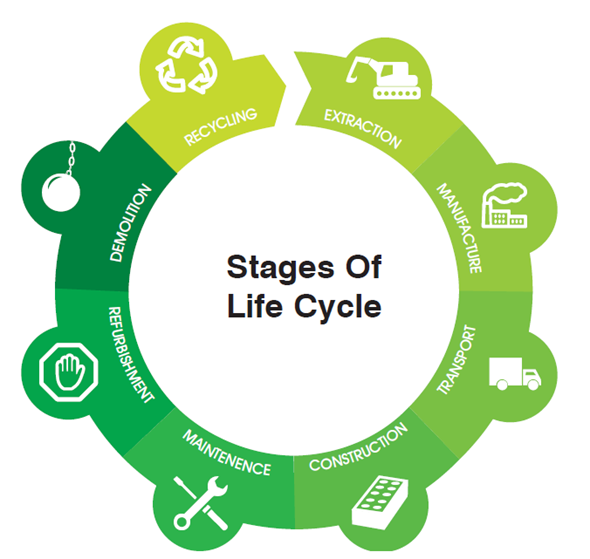
LCA breaks down a building’s life into five main stages:
-
Raw Material Extraction: Sourcing natural resources for building materials. This stage uses energy and impacts ecosystems.
-
Manufacturing & Processing: Turning raw materials into construction products. This phase consumes energy and generates emissions.
-
Transportation: Moving materials to construction sites. This adds to greenhouse gas emissions and energy use.
-
Construction & Operation: Building assembly and ongoing maintenance. Operation includes energy use for heating, cooling, and lighting.
-
End-of-Life (Disposal): Demolition, waste management, and material disposal. Recycling and energy recovery reduce environmental impact.
Each stage shapes the building’s environmental footprint. Assessing all stages helps find sustainability opportunities and avoid missing key impacts.
Why Is Building LCA Important in the GCC Region?
The Gulf Cooperation Council (GCC) countries—including the UAE, Saudi Arabia, Oman, Qatar, and Bahrain—are experiencing rapid urban growth and infrastructure development. This growth increases demand for sustainable construction practices to reduce greenhouse gas emissions, conserve natural resources, and comply with regional sustainability frameworks such as Estidama, GSAS, and QSAS.
Building LCA supports these goals by measuring environmental impacts across the entire life cycle, helping stakeholders make informed decisions to reduce carbon footprints and promote resource efficiency.
What Are the Main Stages of a Building Life Cycle?
Understanding the building’s life cycle is essential for effective LCA. The main stages include:
- Raw Material Extraction: Sourcing natural resources like minerals and timber, which involves energy use and ecosystem impacts.
- Manufacturing & Processing: Converting raw materials into building components, consuming energy and generating emissions.
- Transportation: Moving materials to construction sites, contributing to carbon emissions.
- Construction & Operation: Assembling the building and its ongoing energy use for heating, cooling, and maintenance.
- End-of-Life (Disposal Phase): Demolition, waste management, recycling, or energy recovery through incineration or landfill gas capture.
How Does Cradle-to-Grave Assessment Work in LCA?
Cradle-to-Grave LCA evaluates a building’s environmental impact from raw material extraction (“cradle”) through manufacturing, use, and finally disposal (“grave”). This comprehensive model ensures that all environmental inputs and outputs are considered, including energy consumption, greenhouse gas emissions, and waste generation at each stage.
In the GCC, cradle-to-grave assessments help identify hotspots where interventions can reduce carbon emissions and improve sustainability performance.
How Does Cradle-to-Cradle Assessment Support Circular Buildings?
Cradle-to-Cradle assessment extends beyond disposal by promoting circular economy principles. It focuses on designing buildings and materials for continuous reuse, recycling, and regeneration, minimizing waste and resource depletion.
In the GCC context, adopting cradle-to-cradle approaches supports sustainable development by reducing dependency on non-renewable resources and encouraging restorative building practices aligned with regional circular economy goals.
What Is Life Cycle Inventory (LCI) in Building LCA?
Life Cycle Inventory (LCI) is the data collection phase of LCA, involving the systematic gathering of environmental inputs and outputs for each life cycle stage. This includes raw material consumption, energy use, emissions, and waste flows. Accurate LCI is critical for reliable assessments and typically combines primary data from suppliers and sites with secondary data from recognized databases.
All assessments adhere to ISO 14040 / 14044 standards and GCC sustainability frameworks to ensure consistency and credibility.
How Is Life Cycle Impact Assessment (LCIA) Measured?
Life Cycle Impact Assessment (LCIA) translates LCI data into environmental impact categories such as global warming potential, human toxicity, and resource depletion. It evaluates the significance of these impacts to prioritize sustainability efforts.
For example, LCIA quantifies greenhouse gas emissions in CO₂-equivalents, helping to identify materials or processes with the highest carbon footprints. This measurement guides decision-makers in reducing environmental consequences throughout the building’s life cycle.
Which ISO Standards Govern Life Cycle Assessment?
Building LCA in the GCC follows several key ISO standards:
- ISO 14040 & ISO 14044: Define principles, framework, and requirements for LCA.
- ISO 14025: Guides environmental product declarations (EPDs).
- ISO 14064: Provides specifications for quantifying and reporting greenhouse gas emissions.
Compliance with these standards ensures that LCAs are transparent, consistent, and internationally recognized.
What Tools and Software Are Used for Building LCA?
Several advanced software tools facilitate efficient and accurate LCA studies in the GCC:
| Software | Description | Key Features |
|---|---|---|
| SimaPro | Comprehensive LCA modeling software | Detailed inventory analysis, scenario comparison |
| GaBi | Industry-standard LCA tool | Extensive databases, customizable impact categories |
| OpenLCA | Open-source LCA software | Flexible, cost-effective, supports multiple standards |
These tools streamline data collection, impact assessment, and reporting, supporting compliance with ISO standards and green building certifications like LEED and EPD.
What Are the Benefits of Building LCA for GCC Projects?
Building LCA offers multiple advantages for sustainable construction in the GCC:
- Early Design Optimization: Integrates sustainability from project inception.
- Reduced Carbon Footprint: Identifies and mitigates high-emission materials and processes.
- Resource Efficiency: Promotes energy and water savings throughout the building life cycle.
- Certification Support: Provides essential data for LEED, Estidama, GSAS, and other green building certifications.
- Cost Savings: Enables targeted interventions that reduce operational expenses.
Regional Relevance: Accounts for GCC-specific climate, material availability, and regulations.
Case Study: Whole Building LCA in the GCC
A Living Building LCA in the GCC region reported:
- A 41% reduction in methane emissions from septic systems.
- Solar panels generating 44,000 kWh annually, feeding surplus energy back to the grid.
- A 96% decrease in carcinogenic impacts by eliminating toxic chemicals.
These measurable outcomes demonstrate LCA’s value in driving sustainability and regulatory compliance.
Environmental Product Declaration (EPD) vs. Life Cycle Assessment (LCA)
For a detailed breakdown of EPD vs LCA differences, see our comparison guide.
Feature | Environmental Product Declaration (EPD) | Life Cycle Assessment (LCA) |
|---|---|---|
Scope | Product-specific environmental impact declaration (often based on product environmental footprint methods); LCAs can also be used for organisation environmental footprint assessments | Comprehensive analysis of product or building life cycle |
Purpose | Communicate verified environmental data to stakeholders | Assess and improve environmental performance |
Life Cycle Stages Covered | Typically uses cradle to gate assessments or cradle to gate analysis (up to factory gate) | Cradle-to-grave (entire life cycle including use and disposal) |
Use in Certifications | Supports green building certifications (e.g., LEED) | Supports sustainable design and policy decisions |
Data Requirements | Requires detailed product data | Requires broad data on materials, energy, and processes |
Geographic Relevance | Can be region-specific | Adaptable to regional contexts including GCC |
What Challenges Affect LCA Implementation in the GCC?
Common challenges include:
- Limited Regional Data: Scarcity of localized life cycle inventory data affects accuracy.
- Technical Expertise: Need for specialized training to conduct complex LCAs.
- Resource Intensity: Data collection and analysis can be time-consuming and costly.
- Awareness Gaps: Limited understanding among stakeholders may hinder adoption.
Addressing these barriers requires capacity-building, database development, and stakeholder engagement.
What Are Best Practices for Building LCA Studies?
To maximize LCA effectiveness in the GCC:
- Clearly define goal and scope including functional units and system boundaries.
- Use reliable primary and secondary data sources for comprehensive data collection.
- Employ recognized LCA software tools aligned with ISO standards.
- Adapt studies to regional conditions such as climate and material availability.
- Engage independent reviewers for quality control and credibility.
- Integrate LCA findings into design and procurement decisions early.
What Is the Future of Building LCA in the GCC?
The future of building LCA in the GCC is promising, driven by:
- Enhanced data collection technologies and localized databases.
- Increased integration of circular economy principles.
- Growing regulatory requirements and green building certifications.
- Wider adoption of user-friendly LCA software.
- Stronger collaboration among government, industry, and academia.
These trends will make LCA more accessible and impactful for sustainable development.
How Can You Start a Building LCA for Your Project?
Start your building LCA journey by:
- Defining clear objectives and scope relevant to your project.
- Collecting accurate data from suppliers and construction sites.
- Selecting appropriate LCA software like SimaPro or GaBi.
- Consulting with experienced sustainability professionals.
- Reviewing results to identify hotspots and improvement opportunities.
Learn more about our GCC LCA consultation services to guide your sustainable building projects.
Learn more about our LCA consultation services to guide your sustainable building projects.
We also provide end-to-end EPD certification support for manufacturers and building product suppliers.
Glossary
- Life Cycle Assessment (LCA): A systematic evaluation of environmental impacts across all stages of a product or building’s life.
- Life Cycle Analysis: A comprehensive methodology, aligned with ISO standards, for assessing the environmental impacts of products throughout their entire lifespan, from raw material extraction to disposal. It evaluates resource use, emissions, and impacts to support sustainable product design and better decision-making.
- LCA Study: The detailed process of conducting a life cycle assessment, including defining the goal and scope, following ISO standards, and executing the technical phases required for a comprehensive evaluation.
- Environmental Product Declaration (EPD): Verified document communicating a product’s environmental data.
- Global Warming Potential (GWP): A measure of greenhouse gas emissions expressed as CO₂ equivalents.
- Primary Data: Direct data collected from processes or suppliers.
- Secondary Data: Data sourced from databases or literature when primary data is unavailable.
- Cradle-to-Grave: Assessment covering the entire life cycle from raw material extraction to disposal.
- Streamlined LCA: Simplified LCA methods that reduce time and data requirements.
FAQs About Building Life Cycle Assessment in the GCC
It supports sustainable construction by measuring environmental footprints and aligning with regional climate and resource goals.
Raw material extraction, manufacturing, transportation, construction & operation, and end-of-life disposal.
Cradle-to-Grave covers the entire life cycle including disposal; Cradle-to-Cradle emphasizes material reuse and circularity
Yes. Whether residential, commercial, or industrial, LCA provides tailored environmental impact assessments suited to local conditions.
ISO 14040, ISO 14044, ISO 14025, and ISO 14064
Absolutely. LCA outcomes often support certifications like LEED and Environmental Product Declarations (EPDs).
Early integration is best. Incorporating LCA at the design stage enables decisions that significantly reduce environmental impacts.
SimaPro, GaBi, and OpenLCA are commonly used.
By providing verified environmental data for LEED, Estidama, GSAS, EPD, and others
Data gaps, technical expertise, resource demands, and stakeholder awareness.
Define goals, collect data, choose software, and consult experts.
Reduced greenhouse gas emissions, energy savings, and improved resource efficiency.
For Environmental Product Declaration in GCC (EPD)
For Environmental Product Declaration Certifications Click, EPD Certification
For Health Product Declaration in GCC (HPD)
For our other solutions we offer in Middle-East, please click Solutions


