
Cradle to Cradle C2C Certification: Levels, Requirements and Process Explained
Are you making products that are safe for the planet? Do you want to prove your commitment to sustainability? If so, you need to know about the Cradle to Cradle C2C certification. This powerful standard is changing how we make and use goods.
This guide will explain everything you need to know. We will look at the c2c certification levels. We will break down the exact c2c certification requirements. You will also learn the steps needed to get certified.
If you want to achieve cradle to cradle certification UAE, you are in the right place. We help manufacturers and product designers across the GCC. Let us explore how this standard can grow your business and protect our world.
What is Cradle to Cradle (C2C) Certification?
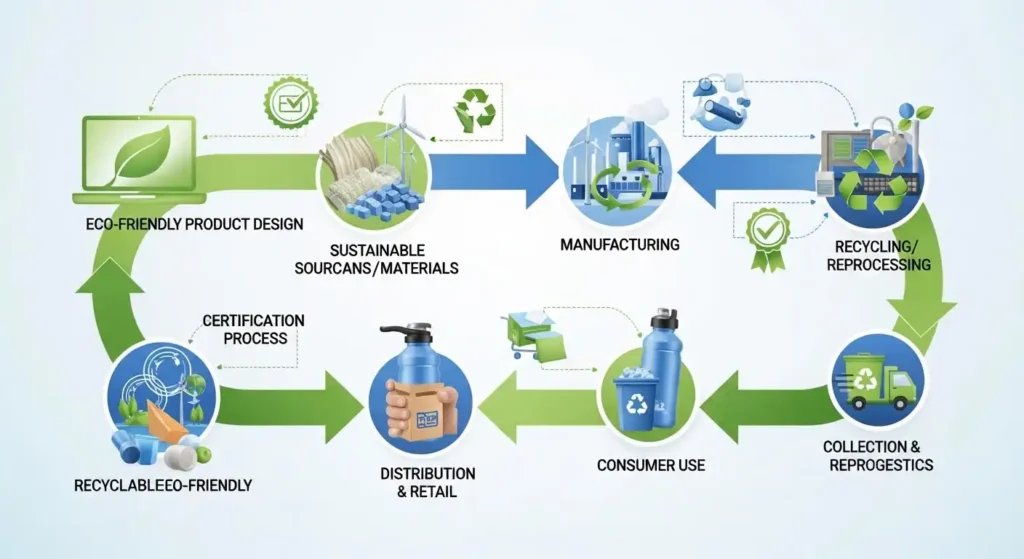
The Cradle to Cradle C2C certification is a global standard for safe products. It focuses on the circular economy certification model. This means products are made to be reused safely.
Most products follow a “take, make, waste” model. This is called cradle to grave. The cradle to cradle meaning is different. It means a product is born, used, and then reborn as something new. It never goes to a landfill.
This c2c product standard checks how a product is made. It looks at the materials inside it. It also looks at the social and environmental impact of the company. It is the best way to prove your product is truly green.
How Cradle to Cradle Certification Works
The Cradle to Cradle certification works on a strict assessment system. Independent assessors check your product against high standards. They do not just look at the final item. They look at your whole supply chain.
The c2c product standard pushes you to improve. You cannot just pass once and stop. You must show progress over time to keep your rating.
Assessors score your product across five areas. Your lowest score in any area becomes your final product grade. This ensures products are safe and sustainable in every way.
5 Core Categories of C2C Certification
Material Health
Products must be safe for humans and nature. Assessors check every chemical used. They ban toxic materials. You must replace harmful chemicals with safe options.Material Reutilization
This category focuses on zero waste. Your product must be recyclable or compostable. You must design it for the circular economy. This means old products become raw materials for new ones.Renewable Energy and Carbon Management
Making products takes energy. The c2c standard requires clean energy. You must use solar, wind, or other renewable sources. You must also lower your carbon emissions over time.Water Stewardship
Water is a precious resource. You must protect clean water during manufacturing. Factories cannot release harmful chemicals into rivers. You must treat wastewater before it leaves your plant.Social Fairness
You must treat workers well. This category checks labor practices. You must pay fair wages. You must ensure safe working conditions. You also need to respect the local community.Cradle to Cradle Certification Levels Explained
Basic Certification
This is the entry level. It is a starting point for companies.- You must know the chemicals in your product.
- You must sign a commitment to improve.
- Products must meet basic water and energy rules.
Bronze Certification
Bronze is the next step up.- You assess at least 75% of materials for health risks.
- You have a basic plan for material reuse.
- You start mapping your carbon footprint.
Silver Certification
The c2c silver level shows strong progress.- You assess 95% of your product’s materials.
- You use safe chemicals.
- You implement a clear water management plan.
Gold Certification
The cradle to cradle gold certification is very strict.- Your product contains zero banned chemicals.
- It is fully designed for material reuse.
- You use at least 50% renewable energy to make it.
Platinum Certification
The c2c platin level is the ultimate goal. Very few products reach this.- Your product is 100% safe for nature and people.
- You use 100% clean, renewable energy.
- Your factory cleans water so well that it is drinkable.
Detailed Requirements for Each Certification Level
Understanding the c2c certification requirements is vital. You must meet strict rules to pass each phase. Here is a clear breakdown of the rules.
Material Health Requirements:
- Basic: Identify all chemicals down to 100 parts per million (ppm).
- Bronze: Assess 75% of the product weight.
- Silver: Assess 95% of the product weight.
- Gold: Phase out all toxic chemicals entirely.
- Platinum: Prove all materials are actively good for health or nature.
Material Reuse Requirements:
- Basic: Define the product’s end-of-life path.
- Bronze: Create a material reutilization score.
- Silver: Have an active recycling plan in place.
- Gold: Prove the product is actively recycled or composted.
- Platinum: Show a fully closed-loop system with zero waste.
Renewable Energy Requirements:
- Basic: Track all energy used to make the product.
- Bronze: Develop a strategy to use clean energy.
- Silver: Use 5% renewable energy and offset 5% of emissions.
- Gold: Use 50% clean energy and offset 50% of carbon.
Platinum: Run on 100% renewable energy and be carbon positive.
Step-by-Step C2C Certification Process
Getting the Cradle to Cradle C2C certification takes time. Follow these exact steps to succeed.
- Eligibility Check:
First, see if your product qualifies. It must be a physical item. It cannot be illegal or dangerous. - Select an Assessor:
You must work with an approved C2C assessor. They will guide you through the rules. - Testing and Data Collection:
You must gather data on your materials. You will check your energy use and water systems. - Assessment:
The assessor reviews your data. They score your product across the five main categories. - Submission:
The assessor sends the report to the Cradle to Cradle Products Innovation Institute. - Approval:
The Institute reviews the findings. If approved, you get your c2c certificate. You must renew it every two years.
Products That Can Get C2C Certification
Many items can earn a c2c certificate. Here are the most common product types.
- Building Materials: Paints, tiles, flooring, and glass.
- Cleaning Products: Soaps, detergents, and industrial cleaners.
- Textiles: Clothing, fabrics, and carpets.
- Packaging: Paper boxes, safe plastics, and glass bottles.
- Furniture: Office chairs, desks, and home decor.
Benefits of Cradle to Cradle Certification
Why should you aim for the Cradle to Cradle C2C certification? The rewards are huge.
- Market Advantage: Buyers want green products. This label helps you stand out from rivals.
- Global Trust: The c2c certified mark is known worldwide. It proves you are not greenwashing.
- Cost Savings: Designing for reuse saves money on raw materials. Saving energy lowers your bills.
- Supply Chain Control: You learn exactly what is in your product. This limits risk and improves quality.
How C2C Certification Supports Green Building and LEED
The green building sector loves c2c certified products. If you sell building materials, this is crucial.
Programs like LEED reward builders who use safe materials. A cradle to cradle gold certification can earn bonus points for a building project.
C2C works perfectly with other major standards. For example, it pairs well with an environmental product declaration UAE. An EPD shows environmental impact, while C2C ensures material safety.
It also aligns with a health product declaration certification. Both focus on keeping harmful chemicals out of our buildings. Using these standards together makes your products highly attractive to architects.
Common Challenges in C2C Certification
Achieving a c2c product standard rating is not easy. You may face a few hurdles.
- Supply Chain Secrecy: Suppliers often hide their chemical formulas. You must convince them to share this data.
- Cost of Testing: Lab tests and assessor fees can be high.
- Time Commitment: The process can take months to finish.
- Continuous Improvement: You cannot rest after winning a c2c bronze award. You must improve to keep it.
Why Choose Envirolink for C2C Certification
You do not have to face these challenges alone. Envirolink is your trusted partner for circular economy certification.
We know the UAE and GCC markets inside out. We help manufacturers navigate complex global rules. Our team works with your suppliers to get the right data. We make the testing process smooth and easy.
We also offer a wide range of sustainability certifications UAE. Whether you need C2C, LEED, or EPD support, we have the skills to help you win.
Get Expert Help for Cradle to Cradle Certification
Are you ready to prove your product is safe and circular? Do you want to reach the c2c gold level?
Do not let the complex c2c certification requirements hold you back. Let our experts guide you from start to finish. We will handle the paperwork, the data, and the strategy.
Contact Envirolink today. Start your journey toward a greener, more profitable future.
FAQs – C2C Certification
It means designing products so they can be reused forever. Instead of going to a landfill, old products become new materials.
Costs vary based on product complexity. You will pay an assessor fee and a certification fee to the Institute.
It usually takes between 3 to 6 months. Gathering supply chain data is the longest part.
Yes. You must renew the certification every two years. You must also show progress during the renewal.
Yes. Packaging is a very popular category for this certification. Safe, reusable packaging is vital for the circular economy.
Yes. Green building projects across the UAE and GCC highly value this certification. It helps projects achieve LEED status.


